The approach to a motorway is usually from a road on the left. Watch for a gap then increase your speed to safely merge with the traffic.
Driving on the motorway
Once on the motorway, stay in the left lane unless overtaking.
If there are three lanes and the left lane has many vehicles travelling at a slower speed than you, stay in the middle lane. After you have passed them, you should return to the left lane. The right lane is generally reserved for overtaking so move out of it as soon as it is safe to do so.
When driving on a motorway you must:
Not stop except in an emergency (if you have to stop, move to the emergency lane, breakdown lane or shoulder)
Not make a U-turn or reverse.
If you miss your exit, continue travelling on the motorway until you reach the next exit.
Leaving the motorway
Make sure you:
Move to the lane closest to the exit in plenty of time
Give a signal and reduce your speed
Check your speed to ensure you are not going too fast to make a safe exit.
Yellow (amber) means stop. You can enter the intersection if you are so close that sudden braking might cause a crash.
Green means proceed through the intersection carefully.
Turning arrows at traffic lights
Some traffic lights have arrows to control traffic turning right or left.
A green arrow means you can only turn in that direction.
A red arrow means traffic waiting to turn must wait behind the stop line until the arrow turns green or disappears, even if there is no traffic on the road.
You must not go straight ahead or turn left. You may turn right.
You must not turn right but you can go straight ahead or turn left if the way is clear.
When the yellow (amber) arrow is flashing, you may proceed but you must give way to any pedestrian who is crossing the road into which you are turning.
Signs at traffic lights
A STOP sign with three black dots is only seen at traffic lights. It means that if the lights are not working or are flashing yellow and you are approaching this sign, you must stop and give way to traffic as though you are at an intersection with stop signs.
This sign allows you to turn left on a red light after stopping. When turning left you must give way to all traffic approaching from the right.
Left turn on red light is only permitted at intersections where the sign has been placed.
B signals
B signals separate buses and other vehicles at some intersections with traffic lights for a safer, smoother traffic flow. To ensure B signals work properly never drive in the lanes marked buses only.
B signals are attached to the usual traffic lights. They show a white B on a black background (some traffic lights have a red, yellow and white B signal attached to them). Shortly before the usual traffic signals change to green, the B signal lights up white. All other vehicles stay while the buses may go. Buses may proceed in any direction unless signs or markings indicate otherwise. When the lights turn green other vehicles may move off.
White B means buses only go
The red and yellow B signals (or the usual red and yellow traffic lights) tell bus drivers when to stop at the intersection.
Left image: Red only means all vehicles stop. Right image: Green only means all vehicles go.
Red B means buses stay. Green means other vehicles go.
Bicycle riders
Where the traffic at an intersection is controlled by traffic lights, cyclists may have signals that show them when to cross. Cyclists must follow these red, yellow or green bicycle symbols and proceed with care
T signals
T signals are special signals for light rail vehicles. These traffic lights display the letter T. Red or yellow T signals tell the drivers of light rail vehicles when to stop or prepare to stop. A white T signal means that the driver of a light rail vehicle can go.
Red light speed cameras
Red light cameras are used to photograph vehicles that go through a red light.
A penalty notice is then sent to the owner of the vehicle, who has the option to:
Pay the fine.
Advise Revenue NSW on a statutory declaration the name and address of the person driving at the time of the offence.
Advise Revenue NSW you want to have the case heard by a court.
If you are crossing the intersection as the light turns yellow (amber) and it is not safe to stop, do not panic. Continue driving through the intersection. The camera only takes a photograph if you cross over the stop line 0.3 seconds after the light has turned red.
Traffic already in the intersection or entering on a yellow (amber) light will not activate the red light camera.
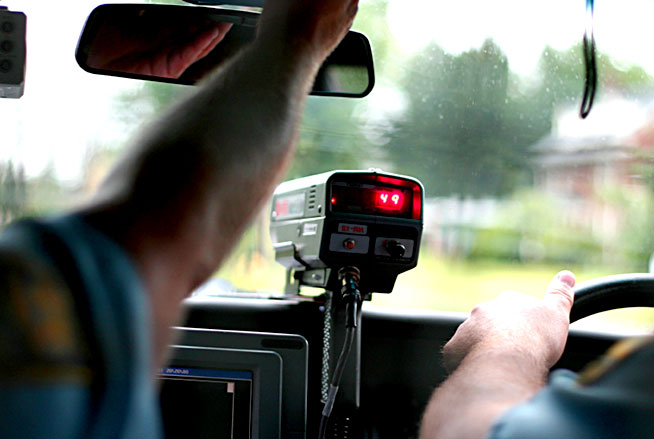
Red light speed cameras use digital technology that is capable of detecting both red-light and speeding offences.
Pedestrian signals
When making a turn at an intersection you must give way to pedestrians on the road into which you are turning.
Where the traffic at the intersection is controlled by traffic lights, there may be signals for pedestrians that show them when to cross.
Pedestrians must follow these signals.
Left image: Pedestrians must not start to cross. Right image: Pedestrians must not start to cross but may finish crossing.
Left image: Pedestrians may start to cross. Right image: Pedestrians may walk in any direction when the green walk signal is accompanied by this sign.
Following another vehicle
To calculate a three-second crash avoidance space when following
another vehicle use this basic technique. As the rear of the vehicle in
front of you passes an object at the side of the road such as a power
pole, tree or sign, start a three-second count ‘one thousand and one,
one thousand and two, one thousand and three’.
If your car passes the object you picked before you finish the threesecond
count, you are following too closely. Your crash avoidance space
is not large enough. Slow down, and repeat the count again until the
three-second crash avoidance space is achieved.
In poor driving conditions, such as rain, night and gravel roads, it may
be necessary to increase your crash avoidance space to four or more
seconds.
To reduce the risk of driving into the rear of a vehicle, the threesecond
crash avoidance space is essential, as the vehicle in front has
the potential to stop very quickly if it collides with another vehicle or
stationary object.
The key to good driving technique is smoothness, and the secret to smoothness is good preparation.
Driving posture
When you first get a car take the time to adjust the seat and controls to suit your height and build. Correct driving posture reduces fatigue, improves your control and allows the safety features of the vehicle to operate effectively.
Seatbelts
For seatbelts to work effectively they should be adjusted ‘low, flat and firm’.
Low – placed below your hips to fully secure your body weight
Flat – no twists, turns or folds
Firm – about every 15 minutes when you drive pull the belt firm to remove any slack.
Airbags
Airbags are a supplementary restraining system (SRS) designed to be used in conjunction with seatbelts. To get the most benefit from the driver’s airbag the steering wheel should be adjusted low, facing the driver’s chest rather than the face.
Braking technique
Correct braking is done in two stages, first put light pressure on the brake pedal and pause (set up the brakes), then progressively apply the necessary braking pressure (squeeze).
Two-stage braking (set up and squeeze) improves braking effectiveness, reduces the likelihood of skidding and provides better control.
Harsh or excessive braking pressure may cause skidding and a loss of control, particularly on wet or gravel roads.
Steering technique
There are two main steering techniques, ‘push/pull’ and ‘hand over hand’. Regardless of which method is used some general rules apply:
Steering must be smooth and progressive
Reduce speed before steering and wait until the vehicle begins to straighten before accelerating
When steering keep both hands on the outside of the steering wheel and
thumbs along the rim.
Electronic driver assist systems
Antilock braking system (ABS)
Antilock braking systems control braking force to prevent the tyres from skidding under heavy braking or when braking in slippery conditions. Some ABS systems cause the brake pedal to pulse or shudder when activated and although this may feel disconcerting, braking effort must be maintained if the situation requires a quick stop.
Traction control systems (TCS)
Traction control systems stop the driving wheels spinning by reducing engine power or temporarily applying the brakes. This allows the car to accelerate smoothly, even on slippery surfaces.
Electronic stability control (ESC)
Electronic stability control detects if a vehicle is not responding correctly to driver steering input. The system selectively applies the brakes to individual wheels or changing engine power, ESC helps the driver to maintain their intended direction.
Emergency brake assist (EBA)
Emergency brake assist detects an emergency brake application. It provides emergency braking assistance and automatically increases the force being applied to the brakes to minimise the stopping distance. It is also known as “Brake Assist System” (BAS).
If you’re moving to NSW from another part of Australia or another country, you’ll need to get a NSW driver or rider licence. You can use your existing licence for up to three months, but after that you must have a NSW licence.
Interstate drivers and riders
If you move to NSW from any Australian state or territory and hold a current licence you can be issued a NSW equivalent licence. NSW will match the expiry date of your licence for no fee up to a maximum of ten years.
The 10-year driver licence option is restricted to the 21 to 44 year age group to minimise the risks of misidentification due to facial changes in young adults under 21. Additionally, the 21 to 44 year age group is currently not required to undertake an eyesight test every five years (see Eyesight tests for more information).
If you have an expired licence of no more than five years, you can be issued a NSW equivalent, fees may apply. If your licence has expired more than five years, licence tests are required and fees may apply.
You need to meet age requirements to be issued with a NSW licence. You must be at least 16 years for a learner driver licence, 16 years and 9 months for a learner rider licence and 17 years for a provisional driver or rider licence.
Your licence will be converted in line with the NSW Graduated Licensing Scheme. You will need to meet the requirements to progress through each stage.
NSW equivalents for interstate driver and rider licences
Interstate licence
NSW equivalent and requirements
Driver, current learner
Learner driver licence.You may be eligible to take a Hazard Perception Test (HPT) and driving test without being issued a NSW learner licence – call us on 13 22 13 or visit a service centre or registry to discuss your personal situation.
Driver, held for less than 12 months
Provisional P1 driver licence.
Driver, held for more than 12 months but less than 3 years
Provisional P2 driver licence.
Driver, held for more than 3 years
Unrestricted driver licence.
Rider, current learner
Learner rider licence.You do not have to attend a pre-learner rider course.
You may be eligible to take a riding test without being issued a NSW learner rider licence – call us on 13 22 13 or visit a service centre or registry to discuss your personal situation.
Expired learner riders are required to pass pre-learner rider training and a rider knowledge test.
Rider, held for less than 12 months
Provisional P1 rider licence.
Rider, held for more than 12 months but less than 3 years
Provisional P2 rider licence.
Rider, held for more than 12 months but less than 3 years and you are 25 or older with a current Australian unrestricted driver licence
Unrestricted rider licence. Riders aged 25 and older meeting these requirements are exempt from the P2 rider licence stage.
Rider, held for more than 3 years
Unrestricted rider licence.
First issue date
We use the first issue date of your interstate licence to work out an equivalent NSW licence. If your interstate licence does not show this date, you may wish to obtain a letter from the interstate licence issuing authority (on their letterhead), confirming your licence details.
Service centres and registries can obtain this information for you, however it can take several days to receive this information from the interstate authority.
What you need to do
To convert your interstate licence, you need to attend a service centre or registry in person, and:
If your interstate licence is expired, you will also need to pay the relevant licence fee.
Your NSW licence card will be posted to you and you’ll receive a temporary paper licence to drive or ride with until your new card arrives.
As you cannot hold more than one Australian licence at a time, we will invalidate your interstate licence, and provide you with a receipt for it. We will also notify the issuing state or territory to cancel the licence in their system.
International drivers and riders
If you’re a permanent Australian resident, or hold a permanent visa under the Commonwealth Migration Act 1958, and you intend to stay in NSW, you are not considered to be a visitor. You can drive in NSW on a current overseas licence for a maximum of three months. Then you will need to apply for a NSW licence to continue driving or riding.
If you do not hold permanent Australian residency, but will be in NSW for more than 3 months, you can apply for a Temporary Overseas Visitor licence.
New Zealand licence holders, regardless of whether you are a permanent or temporary resident, must obtain a NSW licence within three months of living in NSW or stop driving.
You need to meet age requirements to be issued with a NSW licence. You must be at least 16 years for a learner driver licence, 16 years and 9 months for a learner rider licence and 17 years for a provisional driver or rider licence.
Your overseas licence will be taken into account when you apply for a NSW licence and you may be required to pass medical and driving tests. Licences issued in line with the NSW Graduated Licensing Scheme will need to progress through each stage as required.
Important:
Roads and Maritime reserves the right to require applicants undertake a knowledge test or driving/riding test and may not issue a NSW licence unless we are satisfied an overseas licence is valid.
NSW equivalents for overseas driver and rider licences
Overseas licence
NSW equivalent
Driver, current learner
Learner driver licence.You may be eligible to take a Hazard Perception Test (HPT) and driving test without being issued a NSW learner licence – call us on 13 22 13 or visit aservice centre or registry to discuss your personal situation. A knowledge test may also be required.
Driver, held for less than 12 months
Provisional P1 driver licence.A knowledge test and driving test may be required – call us on 13 22 13 or visit a service centre or registry to discuss your personal situation.
Driver, held for more than 12 months but less than 3 years
Provisional P2 driver licence.A knowledge test and driving test may be required – call us on 13 22 13 or visit a service centre or registry to discuss your personal situation.
Driver, held for more than 3 years
Unrestricted driver licence.A knowledge test and driving test may be required – call us on 13 22 13 or visit a service centre or registry to discuss your personal situation.
Rider, current learner
Learner rider licence.You may be required to pass a rider knowledge test, but are exempt from attending the pre-learner rider training course to be issued a NSW learner rider licence.
Expired learner riders are required to pass pre-learner rider training and a rider knowledge test.
Rider, held for less than 12 months.
Provisional P1 rider licence.You may be required to pass a rider knowledge test and successfully complete the Motorcycle Operator Skills Test (if you live in a declared area) or a Rider Test (if you live outside a declared area). If you fail your test, you can apply for a NSW rider learner licence, but are exempt from attending the pre-learner or pre-provisional rider training course.
Rider, held for more than 12 months but less than 3 years
Provisional P2 rider licence or Unrestricted rider licence.You may be required to pass a rider knowledge test and successfully complete the Motorcycle Operator Skills Test (if you live in a declared area) or a Rider Test (if you live outside a declared area). If you fail your test, you can apply for a NSW rider learner licence, but are exempt from attending the pre-learner or pre-provisional rider training course.
Rider, held for more than 12 months but less than 3 years andyou are 25 or older with a current Australian unrestricted driver licence
Unrestricted rider licence.Riders aged 25 and older meeting these requirements are exempt from the P2 rider licence stage.
You may be required to pass a rider knowledge test and successfully complete the Motorcycle Operator Skills Test (if you live in a declared area) or a Rider Test (if you live outside a declared area). If you fail your test, you can apply for a NSW rider learner licence, but are exempt from attending the pre-learner or pre-provisional rider training course.
Rider, held for more than 3 years
Unrestricted rider licence.You may be required to pass a rider knowledge test and successfully complete the Motorcycle Operator Skills Test (if you live in a declared area) or a Rider Test (if you live outside a declared area). If you fail your test, you can apply for a NSW rider learner licence, but are exempt from attending the pre-learner or pre-provisional rider training course.
First issue date
We use the first issue date of your overseas licence to work out the equivalent NSW licence. When your overseas licence does not show an issue date, check with a customer service representative to determine if you will need a letter from the licence issuing authority (on their letterhead), or a relevant consulate or diplomatic office, (based on information received from the overseas licence issuing authority) confirming your licence details. If the letter is not in English, you will need to provide an official translation
What you need to do
To apply for a NSW licence, you must attend a service centre or registry in person and:
Bring your overseas licence with you
Note: In some circumstances or if you can’t provide your overseas licence, you may be requested to provide confirmation of your overseas licence details and status. A letter from the licence issuing authority (on their letterhead) or a relevant consulate or diplomatic office, (based on information received from the overseas licence issuing authority) confirming your licence details may be accepted. If the letter is not in English, you will need to provide an official translation. You will be advised by a customer service representative if further confirmation of your overseas licence is required.
Your NSW licence card will be posted to you and you’ll receive a temporary paper licence to drive or ride with until your new card arrives.
As you cannot, by law, hold more than one licence at a time in Australia, the details of your overseas licence will be recorded in our system. When you’ve been issued with a NSW licence, including a learner licence, it becomes the licence of authority for you to drive or ride on NSW roads. Your overseas licence is no longer recognised and has no authority while you hold a NSW licence.
When driving or riding in NSW, you must comply with all the conditions, restrictions or limitations applied to your NSW licence. If the Police ask you to produce your licence in relation to a driving matter, you must provide your NSW licence.
If you fail a driving or riding test, your visiting driving/riding privileges will be withdrawn. If you want to continue driving/riding in NSW, you will need to apply for a learner driver licence or learner rider licence and comply with all of the conditions that apply to learners in NSW.
You can re-attempt the driving test provided at least a week has passed since the last driving test. If you held an overseas learner rider licence and failed the riding test, you must obtain a NSW learner rider licence and complete the pre-learner and pre-provisional courses before you can attempt another riding test.
Proof of permanent residency
Roads and Maritime Services accept the following documents as proof of Australian permanent residency:
Australian full Birth Certificate showing parental details. Commemorative certificates are not acceptable (except for 1987 and 1988 NSW Historic Birth Certificates). See the Births, Deaths and Marriages website for information
Australian passport
Certificate of Australian Citizenship
Australian Naturalisation Document
Certificate of Aboriginality
Permanent Resident Evidence (PRE) ImmiCard – Issued before 1 July 2017
Evidence of Immigration Status (EIS) ImmiCard (permanent residency status only)
Current ID document from Australian Passport Office
Current Australian Defence Force photo ID
Overseas passport or travel document which includes a valid Australian permanent residency visa
Note: Roads and Maritime may verify your permanent residency status online with the Department of Immigration and Border Protection. We may also use the Visa Entitlement Verification Online (VEVO) Service to verify permanent residency.
Documents not written in English
If your overseas licence or confirmation letter is not written in English, you must provide an official translation.
Translations are only acceptable if they are from:
Multicultural NSW (previously Community Relations Commission of NSW) Visit the MNSW website for more information
The Free Translating Service provided by the Department of Social Services (DSS). The free translation service is only available to eligible people. Visit the DSS website for more information.
For South Korean (Republic of Korea) licences only, we accept translations from the Consulate-General of the Republic of Korea, as the Consulate verifies the licence details with the relevant South Korean (Republic of Korea) issuing authority
For China’s Taiwan Province (Taiwan) licences only, we accept translations from the Taipei Economic and Cultural Office (TECO), Sydney, as TECO verifies the licence details with the relevant issuing authority.
Translations obtained through any other means are not acceptable.
Exemptions from knowledge and driving tests
You may be exempt from knowledge and/or driving tests if:
You have held an Australian driver licence expired within the last five years, and this can be verified with the issuing authority
You hold a current New Zealand licence (not a learner or paper licence)
You hold a current foreign driver licence (not a learner), or one expired within the last five years, issued by a recognised foreign licensing authority.
Recognised foreign driver licences
Roads and Maritime Services recognises car and rider licences issued by certain foreign licensing authorities. There are two categories of recognised foreign licensing authorities – A and B.
If you are applying for a heavy vehicle licence (classes LR, MR, HR, HC or MC) you must pass the relevant knowledge and driving tests, even if you hold an equivalent class licence from a recognised foreign licensing authority.
Recognised Foreign Licensing Authority A: If you hold a licence issued by a licensing authority in one these places, you do not have to pass knowledge and driving tests when applying for a NSW car (class C) or rider (class R) licence:
Austria
Belgium
Bosnia and Herzegovina
Canada (any State)
Croatia
Denmark
Finland
France
Germany
Greece
Guernsey
Ireland
Isle of Man (licences issued since 1 April 1991)
Italy
Japan
Jersey
Luxembourg
Malta (licences issued or renewed since 2 January 2004)
Netherlands
New Zealand, (except for paper licences)
Norway
Portugal
Singapore
Spain
Sweden
Switzerland
United Kingdom
United States of America (any State).
Recognised Foreign Licensing Authority B: If you hold a licence issued by a licensing authority in one of these places and are 25 years or older, you do not have to pass knowledge and driving tests when applying for a car (class C) or rider (class R) NSW licence:
Bulgaria
Republic of Cyprus
Czech Republic
Estonia
Hong Kong (Important: Hong Kong licence holders must have held a Hong Kong licence for a minimum period of 12 months)
Hungary
Latvia
Lithuania
Poland
Romania
Serbia
Slovakia
Slovenia
South Africa
South Korea (Republic of Korea)
Taiwan
If you hold a licence issued by a licensing authority on List B and are under 25, you must pass the relevant knowledge and driving tests.
Non-recognised licensing authorities: If you hold a licence issued by any other licensing authority, you will need to pass knowledge and driving tests when applying for an equivalent NSW licence.
Important: In some cases, the recognised licensing authority exemption may not apply, for example:
If you hold a licence from an external territory of a place on List A or List B, you must pass knowledge and driving/riding tests
If you failed a NSW knowledge test before 17 January 2005, you must re-sit and pass the relevant knowledge test
If you failed a driving or riding test before 20 May 2002, you must re-take and pass the relevant driving or riding test
If you hold a licence issued by a licensing authority on List B, and you failed a knowledge test and/or driving test before 18 February 2013 you must re-take and pass the relevant test
If a Hong Kong licence has been issued for less than 12 months.
If you do hold a licence issued by a recognised licensing authority and are exempt from licensing tests, you should read the Road Users Handbook and/or the Motorcycle Riders’ Handbook to learn the current road rules in NSW.
Information in other languages
If you’d like to talk to us in your own language, the Translating and Interpreting Service is available at service centres and registries. Ask at the counter.
Earning points is usually a good thing. Frequent flyer points, store loyalty points, or even scoring points for your soccer team.
Demerit points, on the other hand, don’t work that way. In fact, it’s the opposite. Earn enough points and you’ll end up losing (your licence) rather than winning.
You get points by breaking the road rules. The number of points you get varies based on the rule.
Get too many points and your licence will be suspended:
Learner and P1 drivers will have their licence suspended for least 3 months if they get 4 or more demerit points over 3 years.
P2 drivers face losing their right to drive if they get 7 or more points in 3 years.
Unrestricted drivers are suspended when they reach 13 points in 3 years.
Also, P2 licence holders who receive a licence suspension for unsafe driving behaviour must stay an extra 6 months on their licence for every licence suspension they receive. This happens when a P2 licence holder is suspended for a demerit point offence or a suspension for committing a higher risk road traffic offence (such as exceeding the speed limit by 30km/h or more).
It is illegal to drive with a suspended licence – you could have to pay a big fine, and might even face jail time.
How to avoid getting points
The best and simplest way to avoid demerit points is to always drive or ride safely and sensibly, and stick to the road rules.
But to really spell it out:
Don’t speed – L and P1 plate drivers will get at least 4 points if they’re caught speeding, which means your licence is suspended straight away.
Don’t drink and drive – a no brainer really. L and P plate drivers can’t drink any alcohol if they’re planning to drive. If you blow more than 0.00, be ready to go to court and hand over your licence.
Don’t use your mobile – it’s illegal for L , P1 and P2 plate drivers to use a phone while driving, in any way. That includes answering or making calls (even hands-free), sending or reading text messages, updating Facebook or checking Twitter.
Wear your signs with pride – your L or P signs should be attached to the outside of your car, front and back. If you’re spotted with them propped up on the dash or taped to the inside windows, you’ll cop two demerit points and a fine. The same applies if all of the letter P cannot be seen.
One mate only – P1 plate drivers under 25 can carry only one passenger younger than 21 in the car with them between 11pm and 5am.
Demerit points for speeding, not wearing a seatbelt or helmet, and mobile phone offences are doubled during long weekends and holiday periods like Easter and Christmas/New Year.
For L and P plate drivers and riders, it’s even more likely you’ll lose your licence on the spot if you break the rules during a double demerit period.
To do this you’ll need to set up an online account with Service NSW if you haven’t already got one – this protects your privacy and keeps your personal information safe.
Fatigue-related crashes can happen on any trip no matter how long or short, or what time of day it is.
Think about the last time you had a big Friday night out, and you had to be up early the next morning to go to work or go play sport? How much sleep did you have, 4 maybe 5 hours? The normal amount of ZZZ’s the average adult needs each night is about 7-9 hours.
Before you jump in your car, Geared suggests you testyourtiredself, and find out if you in need a little more R&R before jumping behind the wheel.
Fast facts on driver-fatigue
• Fatigue is one of the big three killers on NSW roads.
• Fatigue-related crashes are twice as likely to be fatal – drivers who are asleep can’t brake.
• In 2012 more people in NSW died in fatigue-related crashes than drink driving crashes.
• Being awake for about 17 hours has a similar effect on performance has a blood alcohol content (BAC) of 0.05.
So before you head out on any trip, think about how tired you are, learn to recognise the early warning signs when driving and know what to do to avoid driving tired.
Watch the Don’ Trust Your Tired Self television campaign on the Transport for NSW YouTube channel.
You’ve done the right thing – you’re not driving home after a night of drinking
But before you stagger home consider this: will you make it? Geared uncovers the truth about drink walking.
The problem with walking home drunk (or even a little tipsy) should be pretty obvious. Alcohol impairs your judgement – which means you can’t accurately judge the speed or distance of an oncoming car. You may think you have enough time to cross the road, but you don’t. Your balance may also be affected and alcohol can also make you sleepy, so you’re not fully alert.
Alcohol can increase your confidence and risk-taking which means you may feel more confident when it comes to crossing a busy road, and incorrectly judge the time and distance of approaching vehicles.
The Who?All pedestrians under the influence of alcohol are at risk. However, males account for more than 80% of alcohol-affected pedestrian fatalities and 82% of pedestrian injuries.
The When?The majority of alcohol-affected pedestrian casualties occur during the late evening and early morning hours, particularly on Thursdays, Fridays and Saturdays. Just over half of all alcohol affected pedestrian fatalities and 41% of all alcohol affected injuries occur at these times.
The Where?The majority of alcohol affected pedestrian fatalities occur within the metropolitan area. However, alcohol affected pedestrian casualties are over-represented in non metropolitan areas as well.
What’s the plan?
Always plan ahead.
Leave your car at home and before you head out for the night, plan how you’re getting back home.
You can do this by:
Finding out whether your local area has an ‘alternative transport’ option (it’s generally free or a gold coin donation) – lots of councils have a late night bus for people who have been out drinking.
Checking out the public transport timetable to see what time the trains or buses are running. Even if the bus won’t take you all the way home, you can still catch it as far as possible then walk the rest of the way – this minimises the distance you’re walking.
Pre-booking a cab or maybe carry a cab charge so that you can get a taxi.
Organising a lift with a friend who isn’t drinking.
Organising to stay at a mate’s place.
Remember when you’re out, always use pedestrian crossings where they are available and try to cross the road in a well lit area.
Alternative transport
Many local areas have a night bus service (free or a gold coin donation) to get you home safety.
These services are run and funded by various local groups such as Liquor Accords, licensed venues and councils, to stop people drink driving and drink walking. Roads and Maritime Services also provide some funding towards the promotion of these schemes.
Alternative transport schemes run across NSW in some areas including Port Stephens, the Central Coast, Newcastle, Maitland, Wollongong, Nowra, Bega, Kiama, Batemans Bay, Sutherland Shire, Manly, Randwick, the Northern Beaches, Huskisson and Ulladulla, as well as in Jindabyne during the snow season.
Many of these services are seasonal or event based, running only for events like New Years Eve. Check with your local licensed venue, or contact your local council to find out what’s available in your area. For southern region areas see the Night Bus website for routes and timetable information.
Watch out for pedestrians
If you happen to be driving around areas where there are pubs, clubs and restaurants at peak times such as Friday or Saturday nights, make sure you take extra care, look out for people crossing the road, and be prepared to stop.
Special conditions are in place for learner drivers to help keep you and others safe on the road
We all know that the majority of drivers (including learners) are able to drive safely and in accordance with the law – but the stats show that drivers under the age of 20 continue to be over-represented in road crashes.
To encourage safe driving among drivers who are under the age of 20, certain restrictions are in place for learner drivers.
One of the restrictions for learner drivers is adhere to a maximum speed limit of 90km/h. View all special rules that apply to learner drivers on the Getting your learner licence page.
As well as the special rules, it’s important that you understand how the demerit points scheme works and the restrictions that apply to your L plate status – after all, you’ll want to make sure you keep hold of your licence and become a safe and responsible driver.
How does the learner drivers demerit point system work?
If a learner licence holder incurs 4 or more demerit points within a three-year period, the licence will be suspended, or a licence application or renewal refused, for a period of three months.
A minimum of 4 demerit points will be imposed on a learner driver for committing a speeding offence.
This means a learner licence will be suspended or refused for three months for any speeding offence.
Learner drivers can also lose their licence for higher levels of speeding
An additional three-month suspension will apply for exceeding the speed limit by more than 30 km/h.
A six-month suspension applies for speeding more than 45km/h.
Police can also suspend and confiscate learner licenses at the roadside for speeding more than 30 km/h over the limit or if caught driving without a supervisor.
A learner driver does have the right to appeal a decision to suspend or refuse a licence under the demerit points or excessive speed schemes.
Heavy penalties, including a jail sentence and disqualification from driving, may be imposed by a court if a learner driver is convicted of driving while their licence is suspended or refused.
For more information, including a full list of the offences which attract demerit points, visit the Demerit points page or phone 13 22 13.
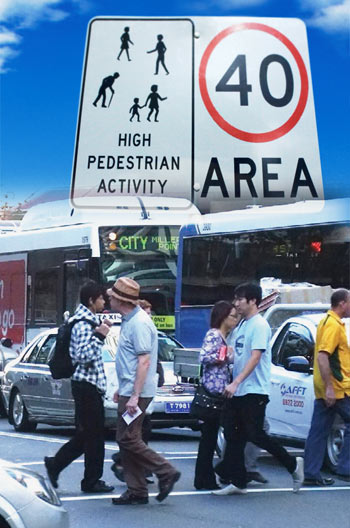
Speed is the biggest single danger on NSW roads, contributing to about 40 per cent of road fatalities each year. International and Australian research shows that even small reductions in vehicle speed can reduce the number of deaths and the severity of injuries caused by crashes. A small decrease in vehicle speed can make a big difference to your chances of survival.
If a car hits a pedestrian at 50 km/h the pedestrian is twice as likely to die than if the driver had been travelling at 40 km/h. For every extra kilometre per hour of speed:
The stopping distance increases
The time to react and avoid a crash decreases
The impact of a crash is more severe on the vehicle, driver, passengers and pedestrians
There is more likelihood of serious injury or death
To help reduce the road toll, we develop strategies to set safe speed limits, including speed zone reviews for the top 100 roads.
On the Safer Roads NSW website, you can sign up for regular email updates on speed zone changes in your area.

 When driving on a motorway you must:
 Red means stop. Wait behind the stop line.
 Yellow (amber) means stop. You can enter the intersection if you are so close that sudden braking might cause a crash.
 Green means proceed through the intersection carefully.
 You must not go straight ahead or turn left. You may turn right.
 You must not turn right but you can go straight ahead or turn left if the way is clear.
 When the yellow (amber) arrow is flashing, you may proceed but you must give way to any pedestrian who is crossing the road into which you are turning.
 A STOP sign with three black dots is only seen at traffic lights. It means that if the lights are not working or are flashing yellow and you are approaching this sign, you must stop and give way to traffic as though you are at an intersection with stop signs.
 This sign allows you to turn left on a red light after stopping. When turning left you must give way to all traffic approaching from the right.