SPEED CAMERAS NSW Australia
Speed camera support enforcement conducted by NSW Police. They are proven
to change driver behaviour and reduce road trauma.
There are four types of speed cameras used in NSW to encourage drivers to
comply with the speed limit – mobile, red-light speed, fixed and point -to point.
All speed cameras are regularly tested to ensure they are measuring speeds
accurately and fine revenue raised from speed cameras goes directly towards
improving road safety. MOBILE SPEED CAMERAS
Mobile speed cameras are moved around the road network and are used statewide,
on all types of roads, at all times of day. Like police enforcement, the exact
location of mobile speed camera enforcement is unpredictable. RED-LIGHT SPEED (SAFETY) CAMERAS
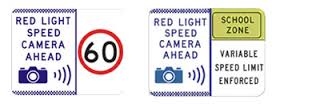
Red light speed cameras are capable of detecting both red light and speeding
offences and are used at high risk intersections. They improve safety by reducing
crashes caused by red-light running and speeding FIXED SPEED CAMERAS
Fixed speed cameras are used at locations with a crash history or that are identified
as high risk – including blackspots, school zones, tunnels and motorways. POINT-TO-POINT CAMERAS
Point-to-point speed cameras work by calculating a driver’s average speed between
two points. If the average speed is higher than the posted limit, a speeding
infringement may be issued.
SCHOOL BUSES
Be particularly careful when passing stationary buses from 7am–9.30am and 2.30–
5pm. This is when children are travelling to and from school. SCHOOL BUS LIGHTS
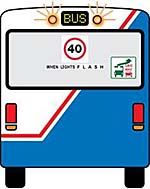
Buses use signs and orange flashing wigwag lights to
warn you that they are picking up or setting down
school children. The lights begin to flash when the bus
stops and the doors are opened. They keep flashing for
about 30 seconds after the doors close and continue
even after the bus moves off. You must not drive past
the bus in the same direction at more than 40 km/h
while the lights are flashing as there may be children
crossing or about to cross the road. SCHOOL BUS HEADLIGHTS
When buses are dropping off or picking up school children their headlights will
also flash. Be careful when approaching a bus with flashing headlights as there may
be children crossing or about to cross the road.
Basic driving techniques
The key to good driving technique is smoothness, and the
secret to smoothness is good preparation.
DRIVING POSTURE
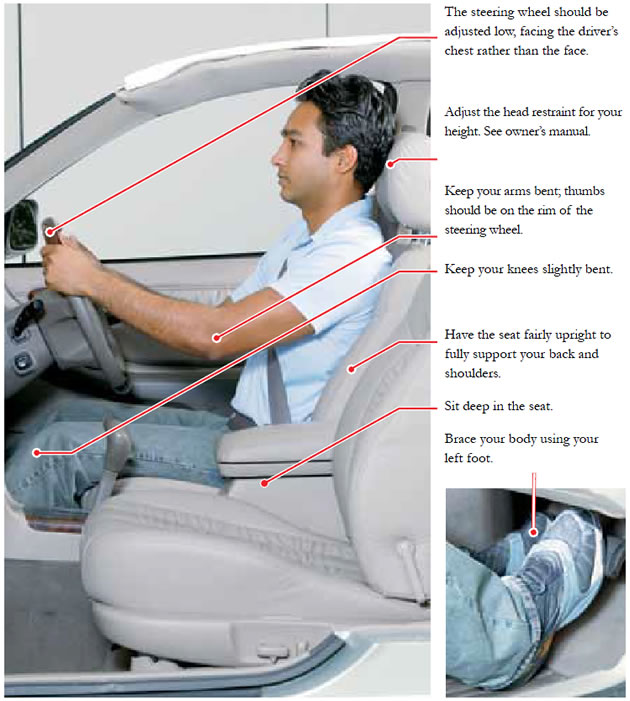
When you first get a car take the time to adjust the seat and controls to suit your
height and build. Correct driving posture reduces fatigue, improves your control
and allows the safety features of the vehicle to operate effectively.
SEATBELTS
For seatbelts to work effectively they should be adjusted ‘low, flat and firm’.
• Low – placed below your hips to fully secure your body weight.
• Flat – no twists, turns or folds.
• Firm – about every 15 minutes when you drive pull the belt firm to remove any
slack.
AIRBAGS
Airbags are a supplementary restraining system (SRS) designed to be used in
conjunction with seatbelts. To get the most benefit from the driver’s airbag the
steering wheel should be adjusted low, facing the driver’s chest rather than the face.
BRAKING TECHNIQUE
Correct braking is done in two stages, first put light pressure on the brake pedal
and pause (set up the brakes), then progressively apply the necessary braking
pressure (squeeze).
Two-stage braking (set up and squeeze) improves braking effectiveness, reduces
the likelihood of skidding and provides better control.
Harsh or excessive braking pressure may cause skidding and a loss of control,
particularly on wet or gravel roads.
STEERING TECHNIQUE
There are two main steering techniques, ‘push/pull’ and ‘hand over hand’.
Regardless of which method is used some general rules apply:
• Steering must be smooth and progressive.
• Reduce speed before steering and wait until the vehicle begins
to straighten before accelerating.
• When steering keep both hands on the outside of the steering wheel and
thumbs along the rim.
ELECTRONIC DRIVER ASSIST SYSTEMS ANTILOCK BRAKING SYSTEMS (ABS)
Antilock braking systems control braking force to prevent the tyres from skidding
under heavy braking or when braking in slippery conditions. Some ABS systems
cause the brake pedal to pulse or shudder when activated and although this may
feel disconcerting, braking effort must be maintained if the situation requires a
quick stop.
TRACTION CONTROL SYSTEMS (TCS)
Traction control systems stop the driving wheels spinning by reducing engine
power or temporarily applying the brakes. This allows the car to accelerate
smoothly, even on slippery surfaces.
ELECTRONIC STABILITY CONTROL (ESC)
Electronic stability control detects if a vehicle is not responding correctly to driver
steering input. The system selectively applies the brakes to individual wheels or
changing engine power, ESC helps the driver to maintain their intended direction.
EMERGENCY BRAKE ASSIST (EBA)
Emergency brake assist detects an emergency brake application. It provides
emergency braking assistance and automatically increases the force being applied
to the brakes to minimise the stopping distance.
It is also known as “Brake Assistto the brakes to minimise the stopping distance. It is also known as “Brake Assist
System” (BAS).
Electronic driver assist systems will not prevent a loss of control or crash if the physical limits of the vehicle are exceeded.
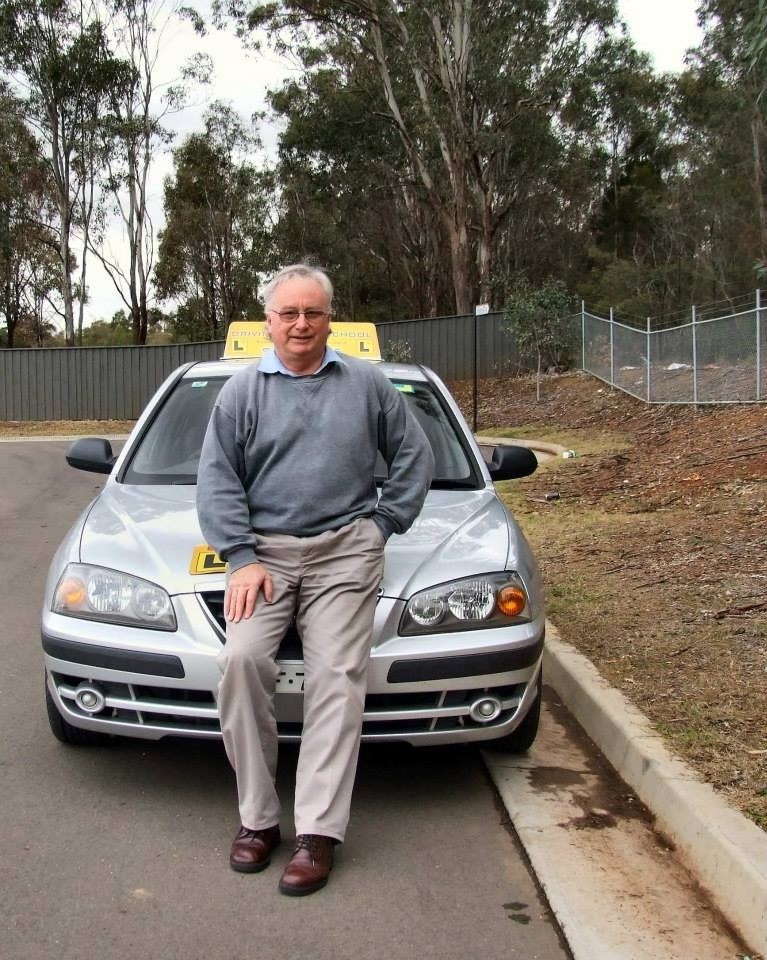
After not being passing my test for 5 times and attending couple of different driving schools, I finally had my driving lesson with Cameron at Camber Driving School today. It was a 2 hour lesson, I was quite nervous but Cameron was very encouraging and calm we went through practising turns and crossing at junctions, parkings. After two hrs we went to rta and then finally i PASSED!!!!
Yayyy I would never have been able to do it without Cameron amazing guidance, he was always calm when I was panicking and gave me confidence in my own judgments.
Thank you so much Cameron.
Cheers
Anum Hammad
From 16 March 2015, the following licensing rules for temporary visiting drivers from overseas have been removed
The minimum six month waiting period before a temporary overseas visitor can apply for a NSW driver licence
The maximum term of a licence of 12 months
Visiting drivers may now apply for a licence with a 1, 3, 5, or 10 year expiry date.
The Q condition code will still remain on the licence issued to a temporary overseas visitor to indicate that evidence of permanent residency has not been provided.
For more information see Applying for a NSW licence as a temporary overseas visitor.
Unregistered vehicles are less likely to have had a safety inspection, and pose a serious road safety risk.
You can be spotted easier than you thought!
Roads and Maritime Services use all types of enforcement cameras to check if a car is unregistered and uninsured.
Vehicles caught committing a camera detected offence are also checked for valid registration and CTP insurance.
This means that if you’re caught committing an offence by an enforcement camera such as a speeding or red light camera, your number plate information will be checked against Roads and Maritime Services records to determine if the car you’re driving is unregistered and/or uninsured.
Unregistered vehicles can pose a serious road safety risk to motorists and the wider community as the vehicles are less likely to have had a safety inspection.
Plus, if you’re caught driving an unregistered vehicle, you could receive a fine of $516. If the vehicle is also uninsured you could be hit with an additional $516 fine. So it’s a good idea to make sure the vehicle you are about to drive is registered and insured before you set off on the road.
Unregistered vehicles using the road network represent an estimated loss of $15 million every year in registration fees and motor vehicle tax that would otherwise be used to fund road safety initiatives, and construction and maintenance projects across the state.
It’s a sad fact that, personal injury claims caused by unregistered vehicles cost more than $19 million a year in NSW, which means these people are pushing the cost of CTP insurance up for everyone.
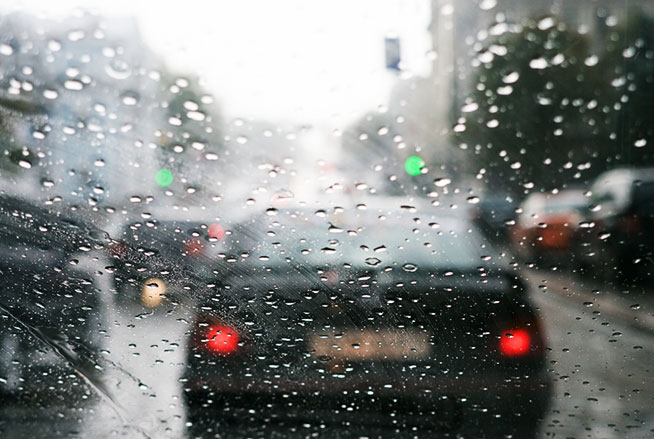
When the rain comes down, the roads can get crazy.
The streets are busier as more people drive to avoid the rain and the roads become slippery. There’s the water itself, but the rain also brings oil and other slippery muck to the surface.
It’s harder to see the road ahead, your windscreen becomes foggy and your brakes are less effective.
It’s no surprise that in the wet weather there are more prangs, but there are some simple things you can do to avoid getting into trouble.
Slow down
It seems obvious, but it’s always a good idea in wet weather to ease up on the gas.
You should also increase the distance between you and the cars ahead.
In normal conditions, it’s recommended that you leave a three second gap – in the wet, try to double this.
Take it easy
You need to take extra care in all aspects of your driving. Accelerate and steer smoothly. Avoid slamming on the brakes – apply steady pressure.
Look out
Make sure you can see and be seen. Turn on your lights and use your air conditioner and/or demister to keep your windows from fogging up.
In heavy rain, you’ll wish you had replaced those worn old windscreen wipers. Before that happens, check out whether you need new ones – they’re cheap to buy and easy to install.
Watch out
Keep an eye out for water on the road. Sometimes water can gather in dips or unseen potholes, creating deceptively deep pools.
Cars have been known to ‘aquaplane’ after hitting water like this (that is, ‘glide’ out of control across the road).
If you do come across water across the road, then cut your speed right back to 30 or 40km/h. After you’ve driven through, touch your brakes lightly to dry out the brake pads.
Obviously, if there’s water flowing across a road in a low-lying country area, for example, you should stop and check the depth before continuing (it shouldn’t be higher than the lowest point on the wheel rim).
Patience
The most important thing is to be patient. When it’s raining and chaotic, everyone’s in the same boat…
NSW Police Traffic Services Commander, Chief Superintendent John Hartley, says there’s little doubt that distracted drivers can cause traffic problems and road crashes.
He explains that there are many distractions on the road, including more and more traffic.
Additionally, drivers now also have to contend with new or more affordable technologies like smart phones, MP3 players, GPS devices, and in-car DVDs, which can act as a distraction.
Here are some of the worst driver distractions:
Mobile phones (talking and texting)
Using a mobile while driving can increase the risk of a collision by four times, according to several studies. Sending a text message is even worse.
Learner and P1 drivers are not allowed to use ANY function of a phone (including hands-free) while driving.
P2 drivers may only use a mobile phone to make or receive a call, or use the audio player if the phone is secured in a fixed mounting. If you are a P2 driver, and your phone is not in a mounting, to answer your phone it must not require you to touch or manipulate the phone in any way.
All other functions such as texting, video messaging, online chatting, reading preview messages and emailing are not allowed. The new laws make it clear that a driver in a moving or stationary vehicle (unless parked) MUST NOT HOLD a phone in his or her hand other than to pass the phone to a passenger.
Adjusting vehicle settings
This is the most common bad driving habit because many people don’t realise it’s dangerous to fiddle with the radio, air-conditioning or windows while driving.
“Crashes often occur as a result of only a moment’s inattention,” says Commander Chief Superintendent John Hartley.
“While you’re changing the CD or skimming through songs on your mp3, your full attention isn’t on the road and [it is] placing you at risk of a crash.” The best idea is to make any adjustments before you set off or put your mp3 on shuffle before you begin your journey.
Passengers
Young drivers have a greater risk of crashing when they have friends in the car.
The stats also tell us that there’s more chance of causing a fatal crash when you have two or more friends in the car, especially male passengers. However, the risk is reduced when carrying an adult or a child, compared with carrying no passengers.
Eating, drinking and smoking
Aside from the obvious dangers of drink-driving, even sipping on a non-alcoholic drink takes your focus off the road.
An American study has found that eating a cheeseburger can be more distracting than talking on a mobile. And the risk of causing a crash is just one more reason not to smoke!
External distractions
As if there wasn’t enough happening inside the car, there are lots of distractions outside too. Make sure you look out for other drivers and pedestrians, while trying to block out the roadside billboards, shops and all sorts of unexpected or interesting things going on in the streets.
Driving is never risk free, but you should aim to drive ‘low risk’.
A low risk driver has good observation, speed management and road positioning skills.
NSW Safe Driving – OBSERVATION
The key to good observation is scanning.
Scanning is keeping your eyes moving, checking in one area for a couple of seconds and then moving your eye to another area.
When scanning look:
• In the distance.
• At the road surface.
• To your left and right.
• Regularly at your mirrors and instruments.
NSW Safe Driving – SPEED MANAGEMENT
Drive at a speed that is within the speed limit and this will allow you to react and
completely stop within the distance you can see is clear. When you see potential
hazards, slow down and prepare to stop (referred to as setting up the brakes), for
example when pedestrians are close to the road or when other vehicles may turn in
front of you. If you cannot see at least five seconds ahead you must slow down.
Slow down on wet, icy or gravel roads where it will take longer for your vehicle to
stop.
What is a Hazard ?
A hazard is any possible danger that might lead to a crash. Hazards can be
seen or unseen, actual or potential, for example.
• A pedestrian waiting to cross.
• A blind corner.
• A car approaching a stop sign on an adjacent street.
• Poor driving conditions.
Safe Driving – ROAD POSITIONING
Position your vehicle to maximise the distance from hazards (referred to as
buffering). For example, moving to the left at the crest of a hill to create space
from oncoming vehicles, or moving away from parked cars to avoid pedestrians
and doors opening.
Check your mirrors before making any change to your speed or position.
Crash avoidance space
A safe low risk driver maintains a crash avoidance space completely around the
vehicle.
The crash avoidance space is managed by adjusting the vehicle’s speed and
road position.
To determine the crash avoidance space to the front of the vehicle you need to
take into account two key factors – reaction time and response time.
Reaction time is the time the driver needs to:
• See the information.
• Perceive what it means.
• Decide on a response.
• Instigate that response.
A driver who is fit, concentrating, alert and not affected by alcohol, drugs, fatigue
or a distraction, will still require about one and a half seconds to react to a hazard.
Response time is the time required to take action.
Generally a minimum of one and a half seconds is needed to respond. In many situations braking may be the only possible response. Swerving is rarely appropriate and can result in a more severe crash, for example a head-on collision.
A total of three seconds crash avoidance space is needed to react and respond to a
situation in front of you. You may need even longer in poor conditions such as in
rain or darkness.
Driver Fatigue accounts for about 20% of road deaths in NSW.
Driver fatigue is particularly dangerous because it affects everyone, no matter how experienced a driver you are.
What is driver fatigue?
Fatigue is a term used to describe the feeling of being ‘sleepy’, ‘tired’ or ‘exhausted’.
This is your body’s way of telling you that you need to stop and rest or sleep. The
best way to avoid driver fatigue is to make sure you have plenty of sleep before you
set off. The only way to treat driver fatigue once you have already started driving is to
stop and rest until you are refreshed.
Facts about fatigue Fatigue fact 1 Fatigue is associated with the hours when you would normally be
asleep. The risk of having a fatal fatigue crash is four times greater between the
hours of 10pm and 6am because this is when your body is programmed to sleep.
Your temperature falls and your blood pressure drops so that at night and to some
extent during the afternoon, your ability to perform tasks can be severely impaired.
This includes your ability to drive.
Your circadian rhythms (natural sleep pattern) cause this type of fatigue and there
is nothing you can do to stop it. So if you drive at night or early in the morning
your risk of driver fatigue is increased.
Fatigue fact 2 The average person needs about eight hours of sleep each night
to function normally, teenagers need even more. When you reduce the number of
hours you sleep at night you start to accumulate what is called a ‘sleep debt’. The
only way to treat your sleep debt is by sleeping.
Fatigue fact 3 Fatigue is caused by how long you have been awake. After being
awake for 17 hours the risk of driver fatigue is greatly increased.
Fatigue fact 4 You have a high risk of suffering from fatigue immediately after
you wake up, when you still feel groggy. This is called ‘sleep inertia’ and generally
lasts between 15 to 30 minutes. Wait until you have overcome sleep inertia before
you drive.
All these factors will increase your fatigue.
Fatigue fact 5 The risk of driver fatigue increases with the amount of time you
have spent driving. To reduce fatigue you should aim to stop for 15 minutes every
two hours. But remember, the only cure for fatigue is a good night’s sleep.
Signs of driver fatigue
Driver fatigue severely impairs your concentration and judgement; it slows your
reaction time. In fact, some of the effects of fatigue are as dangerous as the effects
of alcohol on your driving. As you drive, watch for early warning signs of driver
fatigue:
• Yawning.
• Poor concentration.
• Tired or sore eyes.
• Restlessness.
• Drowsiness.
• Slow reactions.
• Boredom.
• Feeling irritable.
• Making fewer and larger steering corrections.
• Missing road signs.
• Having difficulty staying in the lane.
If you feel tired and you notice these signs it is time to STOP. REVIVE.
SURVIVE. Regular breaks every two hours will help avoid fatigue.
Tips on avoiding driver fatigue
• Get plenty of sleep before starting off.
• Avoid starting a long drive at the end of the day.
• Avoid driving between 10pm and 6am or when you would normally be asleep.
• Share the driving if you can.
• Aim to stop for 15 minutes every two hours.
• Pull over and stop when you notice the warning signs of fatigue.
• Have light snacks rather than fatty foods.
• Avoid too much coffee or sweet soft drinks.
• Drink plenty of water – dehydration can cause fatigue.
• Stay away from alcohol at all costs.
• Stop before you’re tired.
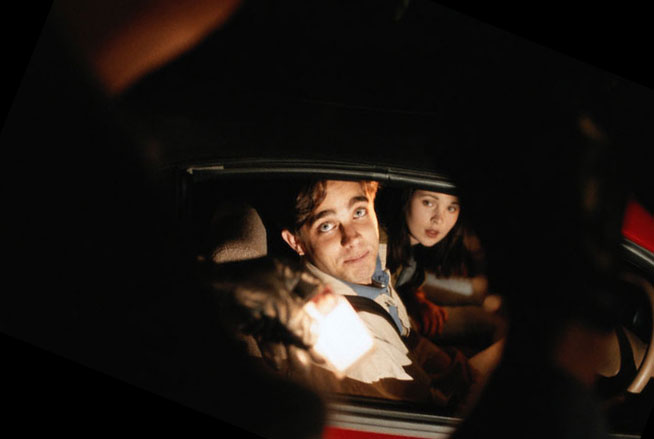
A microsleep is a brief and unintended loss of consciousness.
It is characterised by head snapping, nodding or closing your eyes for
more than a couple of seconds. Microsleeps occur when you try to
stay awake to perform a monotonous task such as driving and can last
from a few seconds to a few minutes.
During a four second microsleep a car travelling at 100 km/h will travel
more than 110 metres while completely out of the driver’s control.