NSW Mobile phone road rules 2016

NSW Mobile phone road rules   2016

Learner and provisional P1 (red Ps) drivers and motorcyclists

Learners and provisional P1 licence holders are not permitted to use a mobile phone at all while driving or riding.
This includes when waiting at traffic lights or stuck in traffic. You must be parked out of the line of traffic to use your phone in any way.

These laws encourage learner and P1 drivers and riders to concentrate on developing their vehicle control and hazard-perception skills.
Mobile phone use can distract novice drivers and riders from the driving task.

From 22 January 2016, learner and P1 drivers and riders penalised for illegally using a mobile phone (four demerit points) will exceed their demerit point threshold and face a three-month licence suspension.

Changes to help keep L and P plate drivers safer

From 1 December 2016, P2 licence holders will no longer be permitted to use a mobile phone at all while driving or riding. P2 licence holders will have the same restrictions as learner and P1 licence holders.

1. Can I hold and use my phone when waiting at traffic lights, or stuck in traffic?
No. It is illegal to hold and use your phone at any time while driving or riding. If you want to hold and use your phone your vehicle must be parked out of the line of traffic.

2. Can I use my mobile phone for calls if it is on loudspeaker and in my lap?
No. It is illegal to have your mobile phone touching any part of your body, other than to pass it to a passenger.

3. Can I have my mobile phone in my pocket if I’m using Bluetooth to make or receive a call?
Yes, if you have a full unrestricted licence or a provisional P2 licence (green Ps).
You can use a mobile phone for calls if it does not require you to touch the phone in any way (e.g. via Bluetooth).
The rules allow your mobile phone to be in a pocket of your clothing.

No, if you have a learner or provisional P1 licence (red Ps), you are not permitted to use a mobile phone at all while driving.

4. Can I listen to music on my phone if it is in a cradle?
Yes, if you have a full unrestricted licence or a provisional P2 licence (green Ps). You can use the audio playing function of a mobile phone as long as the phone is secured in a mounting fixed to the vehicle and doesn’t obscure your view of the road, or the phone can be operated without you touching any part of it, such as via Bluetooth.

No, if you have a learner or provisional P1 licence (red Ps), you are not permitted to use a mobile phone at all while driving.

5. Can I dial a number if my mobile phone is in a cradle?
Yes, if you have a full unrestricted licence or a provisional P2 licence (green Ps). You can use a mobile phone for calls if it is secured in a mounting fixed to the vehicle. Using a mobile phone legally can still be distracting. Consider if the call is urgent and the demands of the traffic before using your mobile.

No, if you have a learner or provisional P1 licence (red Ps), you are not permitted to use a mobile phone at all while driving.

From 1 December 2016, P2 licence holders will no longer be permitted to use a mobile phone at all while driving or riding. P2 licence holders will have the same restrictions as Learner and P1 licence holders.

6. Can I use the GPS function on my mobile phone?
Yes, if you have a full unrestricted licence or a provisional P2 licence (green Ps). You can use a mobile phone as a driver’s aid, such as GPS, as long as it is secured in a mounting fixed to the vehicle and doesn’t obscure your view of the road. You cannot hold your phone to use the GPS function.

No, if you have a learner or provisional P1 licence (red Ps), you are not permitted to use a mobile phone at all while driving.

7. Can I use a GPS device that is not a phone if I am a learner or provisional P1 licence holder?
Yes. A GPS device that is not a mobile phone is permitted for all drivers, as long as the device is secured in a mounting fixed to the vehicle and does not obscure the driver’s view of the road. The device must not be placed in a location that will increase the likelihood of injury in a crash.

8. Can I send a text message if my mobile phone is secured in a cradle?
No. You cannot text at all while driving, whether or not your phone is secured in a mounting fixed to the vehicle.

9. What kind of cradle can I use for my mobile phone?
Your mobile phone must be in a mounting that is commercially designed and manufactured for that purpose.

10. Where can I attach a cradle to my vehicle?
The mounting must be fixed to the vehicle in the manner intended by the manufacturer. It must not obscure your view of the road (in front and to the sides), and must not be placed in a location that will increase the likelihood of injury to you or a passenger in a crash.

 

NSW Practical driving experience – Learner Driver Log Book

NSW Practical driving experience – Learner Driver Log Book

Research indicates that learner drivers who increase their supervised on-road experience can reduce their crash risk by 30 per cent, in the first two years of solo driving. Learner drivers under supervision have a very low involvement in crashes. It is only when they begin to drive solo that their involvement in crashes increases.

Your learner driver log book allows you and your supervising driver(s) to record your driving experience. Take care of your log book. If you need a replacement log book, you will need to attend a registry or service centre and pay a replacement fee.

You must log at least 120 hours of supervised driving, including a minimum of 20 hours of night driving, before you can attempt the driving test. Night driving hours are between sunset and sunrise.

Driving lessons with an instructor – 3 for 1

For every one hour structured driving lesson you complete with a licensed Driving Instructor, you can record three hours driving experience in your Log Book. A maximum of 10 hours of lessons will be accepted and recorded as 30 hours driving experience.

This doesn’t mean that driving lessons with an instructor are compulsory, or that you should stop having lessons once you reach the 10 hour limit, if you feel you’d benefit from more lessons.

Driving lessons at night (between sunset and sunrise) count for only one hour of night driving. The other two hours are added to your day driving hours.

Log it – Be sure to record these sessions in your Structured Lesson Record Keeper log book insert.

Exemptions
You do not have to complete a Learner Driver Log Book if you:

Are over 25 years old

Previously held a NSW or interstate driver licence, other than a learner licence

Previously held an overseas licence, other than a learner licence

Hold an overseas licence, other than a learner licence, and are issued with a learner licence after failing one driving test

Are specifically exempted by Roads and Maritime Services.

Recognition of log book hours recorded in another state or territory

If you’ve held a learner licence in another Australian state or territory, Roads and Maritime will recognise hours recorded in an interstate learner driver log book, as long as you provide appropriate documentation.

Practice drives planner

The Practice drives planner is available for supervisors, parents and learner drivers to plan on-road driving experiences. The weekly calendar-style planner can be put up on the fridge or on the wall, so that everyone gets a reminder to negotiate dates and times for practice drives.

The planner can also stimulate discussion between the supervisor and learner driver about where to drive, and what skills to practice. It helps when negotiating and developing a driving partnership. Learning goals and learning content can be found in the Learner Driver Log Book.

Remember:

Plan for practice on a variety of types of roads with different levels of traffic
Ensure the learner driver is getting variety in the time of day
Make sure you plan some night drives, preferably later in the process.
Safer Drivers Course

The Safer Drivers Course helps young drivers on their Ls prepare for driving solo when they graduate to provisional licences.

The course teaches learners how to reduce road risks and includes ways to cope when you have your mates in the car or if you’re running late by developing safe driving behaviour.

It’s also designed to help you understand more about speed management, gap selection, hazard awareness and safe following distances, which your parents, supervising drivers or professional driving lessons may not have covered.

Earn credit hours

As well as becoming a safer driver, you can earn a bonus of 20 hours of log book credit once you complete the course, so you only need to finish 100 hours of supervised driving outside the course.

The course has been designed for a learner to attend once, and therefore, the 20 hours of bonus log book credit will only be deducted once.

If you also take 10 hours of professional driving lessons, you’ll receive a further 20 hours of credit on top of the 10 hours you drive during those lessons.

Learner driver Credit Supervised driving hours Logbook total
Safer Drivers Course 20hrs
10hrs of professional lessons 20hrs
Safer Drivers Course and 10hrs professional lessons      40hrs

Professional lessons totalling more than 10 hours will not provide additional credit.

More information

To complete a course, you must be on your Ls , aged under 25 and have completed at least 50 log book hours of driving.

The course costs $140 and includes a three-hour group discussion with other learners and a two-hour in-vehicle coaching session with another learner.

The course is available in almost 250 locations across NSW.

NSW LICENCE RESTRICTIONS FOR LEARNERS

NSW LICENCE RESTRICTIONS FOR LEARNERS

Blood Alcohol Concentration  (BAC)
Your BAC must be zero. This means your  (BAC) cannot have any alcohol in your system when you drive a vehicle.
Demerit points
Your licence will be suspended if you incur four or more demerit points.
Display of L signs
L signs must be clearly displayed on the front and back of the exterior of the vehicle.
Seatbelts
You must ensure all occupants are properly restrained by seatbelts or approved restraints.
Speed limit
You must not drive faster than 90 km/h and must observe the speed limit where it is
below 90 km/h.
Supervision
A person who has an appropriate Australian full licence (not a learner or provisional licence or an overseas licence) must sit next to you.
Towing
You must not tow a trailer or any other vehicle.
Location restrictions
You must not drive in Parramatta Park,
Centennial Park or Moore Park when in Sydney.
Mobile phone
You must not use any function of a mobile phone, including hands free or loudspeaker
devices when driving.
Licence class
You cannot learn to drive for a higher licence class.

SUSPENSION OR CANCELLATION OF LEARNER LICENCE
A learner who commits driving offences may have their licence
cancelled by a court or suspended or cancelled by Roads & Maritime.
A learner licence can be suspended by Roads & Maritime for offences
such as:
• The learner drives without a supervising driver.
• The learner or passengers are not restrained by seatbelts or child
restraints, as appropriate.
• The learner drives with a passenger(s) in the boot or on the vehicle.

NSW Drink Driving

NSW Drink driving is a crime. It’s a message that’s been hammered home repeatedly for nearly 25 years.

The good news is that this law, combined with Random Breath Testing (RBT), is estimated to have saved more than 6,000 lives since 1982.

The bad news is that too many people still die on our roads as a result of NSW drink driving – in 2009 nearly one in every five fatal crashes involves NSW drink driving.

The figure is even higher in the country where about one quarter of fatal crashes were connected with drink driving.

Random breath testing started in December 1982 in response to a road toll that had been spiraling right out of control. A spokes person from Roads and Maritime Services says:

“Of all the factors that have helped to reduce the road toll in NSW (such as demerit points, tougher penalties, safer cars etc), RBT has played the biggest role,”.

“In its first 10 years alone, RBT was responsible for about 75 per cent of the reduction in the road toll. In 1982 the road toll was about 1,200 people every year, and now it’s down to around 420. RBT has played a major part in the reduction.”
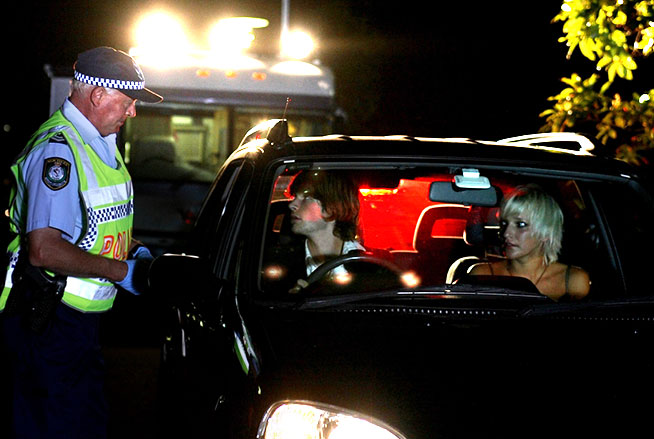
RBT in NSW began with stationary units waving motorists over and police breath-testing drivers after crashes. A couple of years later, each police car was equipped with breath-testing units so drivers behaving in a manner that suggested they might be under the influence of alcohol could be pulled over on the spot.

And now, every police car – including unmarked cars – has an RBT unit and can conduct breath tests.

Blood-alcohol limits
The maximum blood-alcohol level is 0.05. In the ‘60s and ‘70s, the maximum blood-alcohol level was set at 0.08. In response to the continued high incidence of alcohol in crashes, it was reduced in 1990.

In May 2004, a zero blood-alcohol level for L and P plate drivers was introduced to counter the fact that around one third of all NSW drink drivers in fatal crashes were between 17 and 24 years of age, despite the fact they only accounted for about one seventh of licensed drivers. In 1985 the 0.02 level was first introduced for provisional licence holders.

That means, quite simply, that until you have a full licence you cannot drink any alcohol and drive.

A huge fleet
“The chances of being caught if you drive under the influence of alcohol are now greater than ever. Any police officer, at any time, can administer a breath test” says Sergeant Ben Macfarlane, a NSW Police serving Highway Patrol Officer. And they do; over 4.5 million tests were conducted in 2011.

NSW Police can set up stationary RBT sites, where all cars can be waved down, or to conduct mobile testing on any vehicle they suspect is being driven by someone under the influence.

The number of drivers tested is impressive. Sergeant Ben Macfarlane uses his own area of the Blue Mountains as an example.

“You might have two highway patrol cars set up for a couple of hours out of their shift and possibly do between 100 and 200 tests at a stationary site and then they’ll move around and do another 20 or so mobile tests.”
What happens when you’re tested
An RBT or mobile test operates like this:

A driver is waved or pulled over. “We tell them what we’re doing,” says Sergeant Ben Macfarlane.

“People like to know why they’ve been pulled over, obviously. We tell them what’s required and then we ask for a sample of breath. If they refuse, we give them several chances. If they can’t or won’t supply a sample of breath then they’re placed under arrest for the purposes of a breath analysis and taken to the nearest breath analysis station, which can be an RBT truck or bus, or a police station.”
If the driver supplies a sample of breath during an analysis and is under the limit, they’ll be released without charge. If they’re over the limit during the analysis, the driver will be charged according to whatever their reading is.

Drivers who refuse the breath test and then refuse the breath analysis are charged with ‘refusing breath analysis’, which carries the same penalty as a high-range reading.

When drivers drink
As a working policeman, Sergeant Ben Macfarlane has seen all sorts of behavior from drivers under the influence when they’re confronted by an RBT.

“People do all sorts of crazy things,” he says. “You’ve got your basic level of a social drinker who can’t comply with your directions. Then there are people who stop in the middle of the road in busy traffic. You’ve got your next level of people, who will try to get away from the police, who’ll turn-off, do U-turns, turn their lights off and pull over, swap drivers.”
“And then you go up the scale and there’s people who might have more to hide: the car might be unregistered, they may already have been disqualified, or it might be a stolen car. Obviously, they don’t want to be pulled over so they’re going to do all manner of things: shoot through the RBT site, turn back and go the other way. Sometimes people will come quite happily into the site and as soon as we ask them to get out of the vehicle, then they take off.”
And then, of course, there are the scarily drunk people who somehow manage to think they were okay to drive.

“We’ve had people lose control of their bodily functions, in all senses of the word,” says Sergeant Macfarlane. “We’ve had people lose complete control of their emotions. If you could play back a film of what they’d said and done the next day they’d be blown away. We’ve had people not in control of their movements, they may be sluggish or not able to coordinate. So, they’ll be falling over, falling off chairs, and you wonder how they could put themselves behind the wheel.”
There’s no excuse
Sergeant Ben Macfarlane says that faced with the reality of their drink driving, people try to come up with all sorts of excuses.

“People don’t like to take responsibility for what they’re doing and of course they’re very embarrassed,” he says. “Usually they’ve never been pulled over by the police and all of a sudden they’re being told that they’re probably going to lose their licence.”
“I thought I’d be right” is the most common excuse. Sergeant Ben Macfarlane believes this is most often genuine, because people miscalculate how many drinks they can have.

Other excuses include medication interactions with alcohol and emotional issues, such as marriage breakups or job losses but at the end of the day, there’s really no excuse.

NSW Drink driving
NSW Drink driving

Drink driving is a crime

Alcohol and driving Drugs and driving

Alcohol and Driving Drugs and Driving

Alcohol and driving
Alcohol is a contributing factor in about 20 per cent of fatal crashes and five
per cent of those causing injury.

More than half the drivers killed have a BAC of 0.15 or more – three times the
legal limit of 0.05 for full licence holders.

Staying below 0.05 is hard as not everyone takes the same number of alcoholic
drinks to reach this limit.

Women and people of both sexes who don’t weigh a lot get to higher BACs
faster.
Men are more likely to drink and drive and more likely to be involved in
alcohol-related crashes.

Alcohol reduces your ability to concentrate and to look for and respond to
hazards when driving.

Alcohol slows your reflexes when you need to take action such as braking.

Alcohol increases the risk of a crash. Even at a 0.05, crash risk is about twice
what it is at zero.

The safest BAC for driving is zero.

About 57 per cent of fatal crashes in ‘high alcohol hours’ are alcohol-related.

High intake of alcohol occurs mostly weeknights (particularly Thursday
and Friday nights) and weekends.

Drivers with alcohol in their blood are not only more likely to crash, but more
likely to die if severely injured in a crash.

Staying with a zero BAC when driving gives you an edge. It is the safest BAC
for driving regardless of your licence type.

Drugs and Driving
Drugs other than alcohol, including legal medicines and illegal drugs, can affect
your ability to drive safely.
All medicines or legal drugs that may affect your driving are clearly labelled
with warning labels.
Many drugs and medicines interact with each other (and alcohol) in a way that
might affect your ability to drive safely.
Your doctor or pharmacist (chemist) can advise on which medicines affect your
ability to drive.
Illegal drugs carry no warnings and may affect your driving.
Penalties for driving under the influence of drugs include heavy fines, loss of
licence and even prison.

Alcohol and Driving Drugs and Driving

Driver Fatigue STOP, REVIVE, SURVIVE

Driver Fatigue STOP, REVIVE, SURVIVE

Driver fatigue accounts for about 20% of road deaths in NSW. Fatigue is particularly dangerous because it affects everyone, no matter how experienced a driver you are.

What is driver fatigue? Fatigue is a term used to describe the feeling of being ‘sleepy’, ‘tired’ or ‘exhausted’. This is your body’s way of telling you that you need to stop and rest or sleep. The best way to avoid driver fatigue is to make sure you have plenty of sleep before you set off. The only way to treat  fatigue once you have already started driving is to stop and rest until you are refreshed.

Facts about driver fatigue

Fatigue fact 1 Fatigue is associated with the hours when you would normally be asleep. The risk of having a fatal fatigue crash is four times greater between the hours of 10pm and 6am because this is when your body is programmed to sleep. Your temperature falls and your blood pressure drops so that at night and to some extent during the afternoon, your ability to perform tasks can be severely impaired. This includes your ability to drive. Your circadian rhythms (natural sleep pattern) cause this type of fatigue and there is nothing you can do to stop it. So if you drive at night or early in the morning your risk of driver fatigue is increased.

Fatigue fact 2 The average person needs about eight hours of sleep each night to function normally, teenagers need even more. When you reduce the number of hours you sleep at night you start to accumulate what is called a ‘sleep debt’. The only way to treat your sleep debt is by sleeping.

Fatigue fact 3 Fatigue is caused by how long you have been awake. After being awake for 17 hours the risk of driver fatigue is greatly increased.

Fatigue fact 4 You have a high risk of suffering from fatigue immediately after you wake up, when you still feel groggy. This is called ‘sleep inertia’ and generally lasts between 15 to 30 minutes. Wait until you have overcome sleep inertia before you drive. All these factors will increase your fatigue.

Fatigue fact 5 The risk of fatigue increases with the amount of time you have spent driving. To reduce fatigue you should aim to stop for 15 minutes every two hours. But remember, the only cure for fatigue is a good night’s sleep.

Signs of fatigue

Driver fatigue severely impairs your concentration and judgement; it slows your reaction time. In fact, some of the effects of fatigue are as dangerous as the effects of alcohol on your driving. As you drive, watch for early warning signs of fatigue:

Driver Fatigue STOP, REVIVE, SURVIVE

NSW Driving Test Common Mistakes

NSW Driving Test Common Mistakes

The officers agree that the big NSW Driving Test Common Mistakes are the small but important things like signalling – either forgetting to indicate or not doing it for long enough and observation – failing to check your mirrors or blind spots. Stop signs can also be troublesome, particularly when it comes to stopping before the line.

Signalling

Don’t just flick your indicator and drive off, you must signal for at a least 5 seconds before leaving a parking space or moving from a kerb. It is also important to signal at the right time because signalling too early, too late or leaving your indicator on can confuse other road users.

Blind spots

Not checking blind spots is another common error. You need to check your blind spots and mirrors when merging, changing lanes and during your manoeuvres. Drivers often forget to check their left hand side blind spot when turning left off wide roads. Think of it this way, if you could fit a car between the kerb and your car, a head check in your blind spot is required before turning left. You never know when something will be travelling up that part of the road. And don’t forget that an observation check is also required to confirm that it is safe to continue before moving off after being stopped at traffic lights.

Stop signs

A common mistake is not stopping at stop signs and just slowly rolling through. You have to stop the whole car behind the line at a stop sign and traffic lights. Stopping behind the line at traffic lights and then creeping forward does not count – you have to stay behind the line. You can move forward at stop signs when the view may be obscured, but only after you’ve come to a complete stop.

Judgement

Another problem is not selecting safe gaps in traffic. It’s a matter of judgement and experience. Sometimes learners will pull out and misjudge the speed of the car coming towards them or, if it’s a truck, you need to take into account that the truck takes longer to stop than a car.

Right turns

Be decisive, learners trying to turn right at lights can take too long to turn – there may be plenty of room but if you hesitate you can get into trouble.

http://www.rms.nsw.gov.au/geared/your_licence/getting_a_licence/the_big_test.html


NSW Driving Test Common Mistakes

Learning to drive TURNING

Learning to drive TURNING 
Plan your turns early so that you are in the correct part of the road and have
enough time to signal where you want to turn.
LEFT TURNS
You must make a left turn from the left side of the road. When turning:
• Signal left.
• Move close to the left side of the road.
• Keep to the left side of the road you are entering.
• Use a slip lane where one is provided.
When driving on a multi-lane road, you must turn left from the left lane, or from a
lane with a pavement arrow pointing left.
When turning left or right you must give way to any pedestrians
crossing the road into which you are turning.
RIGHT TURNS
When turning right:
• Signal right.
• Move as close to the centre line as possible.
• When turning on a multi-lane road, turn right from the right lane or a lane with
an arrow pointing right. Turn right when it is safe.
• In marked lanes, you must stay in the same lane as you go from one road to another.
• You must give way to pedestrians crossing the road into which you are turning.

Traffic lights
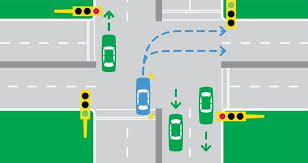
When turning right at traffic lights:
• Enter the intersection as shown in the diagram, unless a sign indicates otherwise
or there is a red right turn arrow displayed.
• Wait until oncoming traffic clears or breaks and then turn safely.
If the lights change to yellow or red while you are in the middle of the
intersection, you are allowed to turn right. You must turn as soon as it is safe to do
so. Be sure your front wheels and car are straight and not blocking the oncoming traffic.


Learning to drive TURNING

Guide to the driving test

road_users_handbook-english

Book a RTA driving test

GIVE WAY RULES WHERE THERE ARE NO SIGNS NSW Australia

GIVE WAY RULES WHERE THERE ARE NO SIGNS NSW Australia
Some crossroads have no traffic lights or signs. Generally if you’re turning across
another vehicle’s path, you must give way.
When turning at an intersection, you (car A in following diagrams) must give way
to:
• Oncoming vehicles going straight ahead (diagram 1 below).
• Oncoming vehicles turning left (diagram 2 below).
• Any vehicle on your right (diagram 3 over the page).
If you and an oncoming vehicle are turning right at an intersection both cars
should pass in front of each other (diagram 4, over the page).
If other drivers do not give way to you, do not force them or yourself into a
dangerous situation.
You must also give way to any pedestrians at or near the intersection on the road
you are entering.

GIVE WAY RULES WHERE THERE ARE NO SIGNS

Seatbelts and child restraints NSW Australia

Seatbelts and child restraints  NSW Australia
SEATBELTS
EVERYONE IN A VEHICLE MUST WEAR A SEATBELT
Everyone in a vehicle, the driver and all passengers, must wear a correctly fitted
and adjusted seatbelt when they are available. A passenger must move to a seat
with a seatbelt rather than sit in one without a seatbelt. If the vehicle does not have
seatbelts fitted, passengers must sit in the back if a seat is available. Passengers
under the age of 7 are not permitted to travel in the front seat without a child
restraint or seatbelt, even if the back seat is full.
It is illegal for a learner or provisional licence holder to drive when not wearing
a seatbelt or carry passengers who are not wearing a seatbelt or using a child
restraint. Learner or provisional licence holders cannot carry passengers if there
are not enough seatbelts.

It is illegal to drive with people in the boot or on the vehicle.

CHILD RESTRAINTS
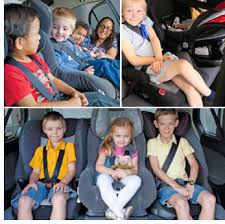
There are legal requirements for children aged under 16 years to use a seat belt or
an approved child restraint. Drivers must ensure children are restrained in devices
suitable for their age and size. Children up to the age of 6 months must be secured
in an approved rearward facing restraint device. From 6 months up to 12 months a
child may be in either an approved rearward or forward facing restraint device.
Children from 12 months up to 4 years must be in an approved forward facing
child restraint. Children under 4 years must not be in the front row of a vehicle
with 2 or more rows of seats.
From 4 years to under 7 years, an approved child restraint or booster seat must be
used. Children from 4 to under 7 years can only sit in the front row of a vehicle
with 2 or more rows, when all other seats are occupied by passengers under 7 years
old.
Approved child restraints must be properly fastened, adjusted and anchored. All
child restraints should be fitted in accordance with the manufacturer’s instructions.
Look in your car manual for the location of anchorage points for child restraints.

WHAT TYPE OF CHILD RESTRAINT TO USE
Child restraints are available in a range of styles to suit children of different sizes.
Restraints are available for children up to 32 kg and/or 10 years old. All child
restraints should be professionally fitted by an Authorised Safety Restraint Fitting
Station, in accordance with the manufacturer’s instructions. When purchasing a
child restraint look for the sticker certifying the child restraint meets Australian
Standard AS1754. When a booster seat is used, it must be used with either an
approved lap and sash seatbelt or an approved child safety harness.
SEATBELTS AND CHILD RESTRAINTS IN TAXIS
Taxi drivers can be fined and given demerit points for every unrestrained passenger
they carry under 16 years of age. Unrestrained passengers aged 16 years and over
travelling in a taxi also receive a fine.
When travelling in taxis, a child under 12 months of age must use a suitable
child restraint. Taxis have anchorage points for your child restraint and some taxi
companies will supply a child restraint if you request one when booking a taxi by
phone. Approved restraints have the Standards Australia label.
EXEMPTIONS
Taxis: Currently, taxi drivers do not have to wear a seatbelt although they are
strongly advised to do so for their own safety.
Medical conditions: In rare circumstances an adult or child may obtain a doctor’s
certificate to say they cannot wear a seatbelt because of a medical condition or
body shape. This certificate must
• be dated and issued on the practitioner’s letterhead
• state the reason for which the exemption is requested
• state the date on which the exemption expires, an exemption should
not exceed one year from the date of the certifcate issued.
This certificate must be carried at all times while travelling unrestrained in a
vehicle, otherwise both driver and passenger will be fined and the driver will get
demerit points.
Reversing: A driver reversing a vehicle does not have to wear a seatbelt.
Tow Trucks: When an appropriate child restraint is not available for use in a tow
truck, a child under 1 year old is allowed to sit on the lap of another passenger
who is not in the front row of seats (if the tow truck has two or more rows of seats).

Seatbelts and child restraints  NSW Australia
Seatbelts and child restraints NSW Australia