NSW – Mobile Phone Use

The dangers of distraction

Driving is a complex task. Anything that takes your mind or eyes off the road, or your hands off the wheel, not only compromises your safety, but that of everyone else on the road.

Make sure you know the rules about mobile phone use when driving and watch our animated video.

Mobile phone detection cameras operate across NSW targeting illegal phone use. The program includes both fixed and transportable trailer-mounted cameras. Along with regular enforcement operations by NSW Police, these cameras target illegal mobile phone use anywhere, anytime.

Being distracted increases your chances of having a crash. It slows down your reaction times and puts you in danger of failing to see hazards such as traffic lights, stop signs or other road users, including pedestrians and bicycle riders. Avoid the temptation of using your mobile phone illegally while driving:

  • Use a mobile phone cradle fitted in your vehicle
  • Get Bluetooth set up or installed in your vehicle
  • Get a passenger to answer your messages/calls
  • Put your phone on silent
  • Activate the ‘Do not disturb while driving’ function on your phone (e.g. Apple iOS or Android)
  • Tell others not to call or text you when you’re driving
  • Divert your calls to voicemail
  • Pull over when and where it’s safe and legal to do so

Our Get your hand off it campaign warns drivers of the dangers of illegal mobile phone use and the serious consequences of taking your eyes off the road.

NSW Safer Drivers Course

Enrol in a Safer Drivers Course

The Safer Drivers Course helps young drivers on their L-plates prepare for driving solo when they graduate to provisional licences. Our video Preparing for your Ps shows how the course helps learner drivers with practical advice and safety strategies.

The course teaches learners how to reduce road risks and includes ways to cope when you have your mates in the car or if you’re running late by developing safe driving behaviour.

It’s also designed to help you understand more about speed management, gap selection, hazard awareness and safe following distances, which your parents, supervising drivers or professional driving lessons may not have covered.

Earn credit hours

As well as becoming safer drivers, you can earn a bonus of 20 hours of log book credit once you complete the course, so you only need to finish 100 hours of supervised driving outside the course.

The course has been designed for a learner to attend once, and therefore, the 20 hours of bonus log book credit will only be deducted once.

If you also take 10 hours of professional driving lessons, you’ll receive a further 20 hours of credit on top of the 10 hours you drive during those lessons.

Learner driverCreditSupervised driving hoursLogbook total
Safer Drivers Course20hrs100hrs120hrs
10hrs of professional lessons20hrs*100hrs120hrs
Safer Drivers Course and 10hrs professional lessons40hrs80hrs120hrs

*This is in addition to the 10 hours spent driving during the lessons. Professional lessons totalling more than
10 hours will not provide additional credit.

More information on the course

To complete a course, you must be on your L-plates, aged under 25 and have completed at least 50 log book hours of driving.

The course costs no more than $140 and includes a three-hour group discussion with other learners and a two-hour in-vehicle coaching session with another learner. The course is available in almost 250 locations across NSW.

The Transport for NSW website has a list of Safer Drivers Course providers. Book directly with the course provider.

Free course for disadvantaged learner drivers

The NSW Government is offering 1000 free places on the Safer Drivers Course each year to help young learner drivers from disadvantaged backgrounds and Aboriginal communities. The fee exemption allows those who are financially disadvantaged to benefit from the road safety outcomes of the Safer Drivers Course.

To be eligible for a free place you need to:

  • Hold a valid learner licence
  • Be aged under 25 years
  • Have completed a minimum of 50 log book hours of actual on-road driving (excluding any 3-for-1 bonus hours) and should include night driving
  • Hold a current Health Care Card or Pensioner Concession Card issued by the Department of Human Services – Centrelink
  • Have been or are currently in Out of Home Care (OOHC)
  • Be a current or former participant of a Driver Licensing Access Program (DLAP).

To apply for a free place you need to contact a course provider to enrol in a course and complete the Safer Drivers Course Concession Application form. You will also need to provide a copy of your Health Care Card or Pensioner Concession Card to your course provider.

Visit the Transport for NSW website to find a Safer Drivers Course provider and speak to them about the free places.

Frequently asked questions

  1. Will I need to supply my own vehicle for the in-vehicle coaching part of the course?
  2. What is the maximum number of participants for a course to be held?
  3. Do I have to complete the course modules in a set order?
  4. What happens if a learner driver only completes module one?
  5. In what circumstances can I receive a refund or partial refund for the course?
  6. Can I fail the course?
  7. How will the 20 hours credit be recorded in my log book after I complete the course?
  8. What happens if I have a log book that was issued before July 2013?
  9. What if I have a grievance/complaint about one of the course providers or their staff?

1. Will I need to supply my own vehicle for the in-vehicle coaching part of the course?

No. A dual-controlled vehicle will be supplied by the course provider.

2. What is the maximum number of participants for a course to be held?

Module one (the group discussion) will be run by a facilitator and the maximum number of participants is 12. Module two (the in-vehicle coaching session) will be delivered by a coach with two learner drivers.

3. Do I have to complete the course modules in a set order?

Yes. Participants must complete module one (the facilitated group discussion), before completing module two (the in-vehicle coaching). Module two should be completed within one month of module one.

4. What happens if a learner driver only completes module one?

The 20 log book hours credit will only be available for learners that have completed both modules of the course within four weeks. Participants should contact the course providers directly to learn more about their cancellation/rebooking policies.

5. In what circumstances can I receive a refund or partial refund for the course?

Course providers are required to tell all participants about their cancellation/refund policy at the time of their booking. Participants can speak to course providers regarding these policies by contacting them directly.

6. Can I fail the course?

No. There is no assessment or pass/ fail component of the Safer Drivers Course. However, participants must complete both course modules to be eligible for the 20 hour log book credit in their learner driver log book.

7. How will the 20 hours credit be recorded in my log book after I complete the course?

As you complete each module the facilitator or coach will enter the details and sign off the course completion in your logbook on page 110, ‘Structured Lesson Record Keeper and Safer Drivers Course Record’. In addition, the driving coach will enter 20 hours credit in the ‘Driver experience record’ section of your log book so you can keep an accurate running total of your log book driving hours.

8. What happens if I have a log book that was issued before July 2013?

You won’t need to get a new log book. The course provider will simply staple a completed and signed insert on page 110, ‘Structured Lesson Record Keeper and Safer Drivers Course Record’ of your log book.

9. What if I have a grievance/complaint about one of the course providers or their staff?

Participants must firstly advise a course provider if they are unhappy with the service or if they seek to make a complaint about a facilitator or coach. If this process is unsatisfactory, you can lodge a formal complaint about a course provider by emailing SaferDriversCourse@rms.nsw.gov.au or telephoning 13 22 13. You can also mail your complaint to: Manager, Operational Policy, Safer Driver Course Administration, Roads and Maritime Services, Locked Bag 928, North Sydney, NSW 2059.

Animals On Country Roads.

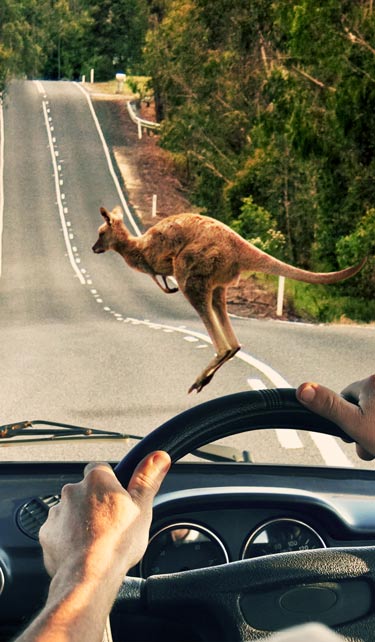
Animals On Country Roads With most of NSW affected by drought and bushfires, increased numbers of wildlife and livestock on the roads pose an added risk to motorists.

The severe shortage of feed has forced farmers to graze stock on the roadsides, while cattle that have escaped in search of feed can be more unpredictable and present a serious road safety danger.

Wildlife, especially kangaroos and wallabies, are also drawn to the roadside, attracted by the feed watered by run-off from the roads.

Temporary warning signs in areas where cattle graze and also in native animal hotspots urge motorists to slow down and watch for animals on the roads.

Animals on country roads

Safe driving tips

One in every 41 casualty crashes on country roads involves a vehicle hitting an animal. Kangaroos, wombats and stray stock can move fast and be extremely unpredictable. When animals stray onto the road it’s hard to know what they’ll do next. Slowing down and being prepared, especially near sunrise and sunset, could save a collision or even save your life.

  • Be aware – animals are more active near waterholes and creeks, and harder to see at sunrise and sunset
  • Reduce your speed – slow down when you see animal  warning signs
  • Stay alert – animals are unpredictable, so expect the unexpected
  • Brake safely – always apply your brakes in a controlled manner
  • Never swerve – it is safer to hit an animal than swerve and lose control of your vehicle
  • Report injured wildlife – call WIRES on
    1300 094 737

If drivers come across a horse being ridden on the road, they should:

  • Slow down and allow plenty of room
  • Never sound the horn, rev the engine or pass at high speed
  • Slow down or stop if the rider is having difficulty.

https://roadsafety.transport.nsw.gov.au/index.html

NSW Street Racing and Other Offences

NSW Street Racing and Other Offences

Tough measures are in place to combat anti-social ‘car hoon’ behaviour. The laws make it clear for irresponsible drivers treating NSW roads as their own personal race track that this is selfish and dangerous behaviour, and will not be tolerated.

The information on this page is a plain English guide only and is subject to change at any time without notice.
Reference should be made to the latest provisions in the law for detailed information on specific offences and penalties.

Vehicle Sanctions Scheme

Introduced on 1 July 2012, the Vehicle Sanctions Scheme allows police to apply roadside sanctions where the following offences are detected:

  • Street racing
  • Aggravated burnout
  • Engaging in a police pursuit
  • Speeding by more than 45km/h.

From Monday 3 December 2018, the Vehicle Sanctions Scheme will also apply to repeat, high risk drink drivers.

Number plate confiscation

Where a driver commits one of the offences above and is the registered operator of the offending vehicle, police may confiscate the number plates at the roadside as an alternative to the long-standing practice of impounding the vehicle. Vehicle impoundment or plate confiscation will be for a fixed three-month period. A person may apply to the local court for an order for the early release of confiscated plates or an impounded vehicle.

There are also tough penalties for people who use a vehicle that has had its number plates confiscated. This includes driving a vehicle with no plates or false plates. Heavy penalties also apply to altering, tampering with or replicating a production notice sticker attached to a vehicle by police when number plates are removed.

Court imposed penalties

The maximum penalties for a person who is convicted of vehicle or plate confiscation offences are as follows:

  • A person convicted of an offence of operating a motor vehicle on a road during a plate confiscation period faces a maximum court imposed fine of $3,300 and vehicle forfeiture
  • A person convicted of an offence or removing, tampering with or modifying a number plate confiscation notice faces a maximum court imposed fine of $3,300 and vehicle forfeiture

Further offences relating to vehicle and number plate confiscation are prescribed under section 244 of the Road Transport Act 2013.

The maximum penalty for a person who is convicted of a street racing or ‘hoon’ offence is as follows:

  • The maximum court imposed fine for an aggravated burnout offence is $3,300 for a first offence and $3,300 and/or 9 months imprisonment for a second or subsequent offence. A 12-month automatic period of disqualification also applies following conviction for the offence
  • The maximum court imposed fine for a street racing offence is $3,300 for a first offence and $3,300 and/or 9 months imprisonment for a second or subsequent offence. A 12-month automatic period of disqualification applies to those convicted of this offence
  • The maximum court imposed fine for an offence of speeding by more than 45km/h is $2,530 for the driver of a light vehicle and $3,740 for the driver of a heavy vehicle. A six-month automatic period of disqualification applies to those convicted of the offence
  • The maximum penalty for a police pursuit offence is 3 years imprisonment and a 3-year automatic period of disqualification for a first offence, and 5 years imprisonment and a 5-year automatic period of disqualification for a second or subsequent offence.

Street racing and burnout offences are prescribed under sections 115 and 116 of the Road Transport Act 2013. Police pursuit offences are prescribed under section 51 of the Crimes Act 1900, and speeding by more than 45km/h in Rule 20 of the Road Rules 2014.

Immediate licence suspension

Police can also immediately suspend a driver’s licence at the roadside following a person being charged with a street racing or aggravated burnout offence. The suspension will remain in place until the charge is determined by a court.

The aggravated burnout offence can apply to persons other than the driver. For example, a hoon driver’s mate who willingly participates in, urges others to participate in, photographs or films to promote or organise hoon activity can also be charged with the offence and faces the same penalties.

Motor vehicle sanctions

NSW Police have the power to confiscate the car of a driver who commits a street racing or aggravated burnout offence, engages in a police pursuit or speeds by more than 45km/h. Police also have additional options to confiscate a vehicle’s number plates, or give the driver or registered operator of the vehicle a notice requiring that the vehicle be produced at a specified place within 10 days. If the vehicle is not produced a court imposed penalty of $3,300 can apply and Roads and Maritime Services can suspend the vehicle’s registration for 3 months.

Where the driver is also the registered operator of the vehicle

In cases where the driver is the registered operator, the vehicle may be impounded or the plates confiscated for a period of 3 months for a first offence. For a second or subsequent offence, the vehicle may be forfeited to the Crown and may be sold or released to Roads and Maritime for crash testing.

Where the driver is not the registered operator of the vehicle

In cases where the driver is not the registered operator, Roads and Maritime may issue a suspension warning notice to the registered operator warning that if the same vehicle is used in a second offence, the registration of the vehicle may be suspended for 3 months.

If a second or subsequent offence is committed, the registration of the vehicle may be suspended for 3 months.

Note: It is not intended that vehicle owners be penalised for the driving offence committed, but rather for failing to adequately supervise use of their vehicle on repeated occasions.

Crash testing by Roads and Maritime

Laws provide that the cars of repeat offenders may be forfeited to the Crown. Usually, those vehicles are sold and the money used to recover storage and collection costs. The laws also allow certain forfeited vehicles to be released to Roads and Maritime for crash testing.

Roads and Maritime will use the unique tests to investigate the potential effects of certain modifications on overall crashworthiness and the wrecks of these vehicles will be displayed at education days for young drivers, or at other Roads and Maritime presentations.Share this page: 

NSW Professional Drivers

NSW Professional Drivers

Eligible professional drivers have an increased demerit points limit of 14 points.

The information on this page is a plain English guide only and is subject to change at any time without notice.
Reference should be made to the latest provisions in the law for detailed information on specific offences and penalties.

Generally, unrestricted licence holders who reach or go over 13 demerit points are sent a Notice of Suspension, or are refused a licence if they apply for one.

Professional drivers however, have a demerit points threshold of 14 points, provided they meet the criteria.

If you can demonstrate you meet the professional driver requirements, any suspension (or refusal) applied based on 13 demerit points exactly will be withdrawn.

If you later reach or go over 14 demerit points however, you will be suspended or refused as for other unrestricted licence holders.

Professional driver status was introduced on 31 January 2011. If you are subject to a suspension or refusal period issued before 31 January 2011, you are not eligible to apply for professional driver status.

Who is eligible?

You are eligible for the increased demerit points limit if you hold an an unrestricted licence and you are a:

  • Motor vehicle driver who transports goods either inter and/or intra-state, or
  • Bus, taxi or hire car driver who holds an authority issued under the Passenger Transport Act 1990.

The following conditions apply:

  • You must earn an income for the driving work and drive more than 20 hours per week. Volunteer drivers do not qualify
  • You must have been a professional driver on the date of your last demerit point offence and on the date the notice of suspension was given (or the date you were refused a licence).

People who are not professional drivers

You do not qualify as a professional driver if:

  • Driving a motor vehicle is incidental to your primary work such as a tradesperson, vehicle repairer, salesperson, carer, tow truck operator, food vendor etc
  • Your primary work is driving an implement (grader, road roller, bulldozer etc)
  • You have not held a licence for more than 6 months because it expired or was disqualified, and you are now applying for a licence
  • Your primary work is personally driving a motor vehicle but the driving is not for the purpose of transporting goods
  • Your primary work is personally driving a motor vehicle to transport people but the driving is not for the purpose of transport under the Passenger Transport Act 1990
  • Your driving is only to transport yourself to your place of work or education.

Interstate licence holders are not eligible to apply for professional driver status.

Applying for professional driver status

If you qualify for professional driver status, you can make an application.

Your application will be considered if you:

  • Have been issued a notice of suspension which has not yet started, or
  • You have been refused a licence renewal and you have held an unrestricted NSW driver licence within the past 6 months, and
  • In either case, you have accumulated exactly 13 demerit points.

An application for a professional driver status will not be considered if you have 14 or more demerit points.

You do not need to have been a professional driver for the whole period during which you accrued the demerit points, however you must have been a professional driver at the date of the last offence, which caused you to reach 13 demerit points, and also at the date the Notice of Suspension was issued or your licence renewal was refused.

Submitting your application

If you have received a notice of licence suspension in the mail, you need to visit a registry or service centre before the suspension period begins.

You will need to:

  • Bring your notice of suspension with you
  • Meet all the requirements for a professional driver
  • Complete the Professional Driver Declaration form available from the registry or service centre
  • If you are a bus, taxi or hire car driver, you will need to provide your current Driver Authority.

If you have been refused a licence renewal because you have reached exactly 13 demerit points, to apply for professional driver status your driver licence must also not have been disqualified or expired for more than 6 months.

Information required on the Professional Driver Declaration form

When completing the Professional Driver Declaration form, you will need to include:

  • The company/business name of your employer (includes self employed)
  • If you are a taxi driver, the name of the taxi operator(s) and taxi network(s)
  • The title of the job you are employed to do (eg truck driver or bus driver)
  • The number of hours per week you are paid to perform this driving work
  • Confirmation that you were a professional driver at the date of your last demerit point offence and at the date you were issued a notice of suspension or the date your licence renewal was refused
  • Your contact telephone number
  • If you are a bus, taxi or hire car driver, the number and expiry date of your Driver Authority issued under the Passenger Transport Act 1990.

Verification of your application

Roads and Maritime may check the information you provide on your declaration. This means that your employer can be contacted about what you are employed to do, the hours you work and to verify that you are paid for that work. We can also verify that the Driver Authority issued to bus, taxi or hire car drivers is valid and current.

Important: Providing false information is a criminal offence. If the information you provide is found to be false, we may request the Police to prosecute. Heavy penalties, including a term of imprisonment, may be imposed by a court on conviction for the offence. We can also suspend your licence.

If your application is successful

If your application for professional driver status is successful:

  • If a Notice of Suspension was issued, it will be withdrawn and your licence will not be suspended
  • If your application for a licence renewal was refused, the refusal will be withdrawn and your licence will be renewed
  • The 13 demerit points you have accrued, and all the related offences, will remain on your driving record.

Important: If you accrue more demerit points, you will be issued with a new Notice of Suspension, or a new refusal period will be applied.

Further applications

If you are issued with a new Notice of Suspension or are refused a licence in future, you must submit a new application for professional driver status, as your employment as a professional driver may have ended since your last application.

If your application is unsuccessful

If Roads and Maritime determines that you do not meet the eligibility criteria for a professional driver, you will be subject to suspension or refusal as for other unrestricted licence holders.

Provided you apply before the suspension begins, you have the option to apply for a Good Behaviour Period. If you elect to be of good behaviour, you cannot apply for professional driver status in the event that you commit further demerit point offences and are being suspended as a result.

Excessive speeding and court disqualifications for serious offences

The professional driver option is part of the demerit points scheme, and so is not available if you have been suspended for an excessive speeding offence.

You are also not eligible if you have been disqualified by a court for a serious offence such as drink driving.Share this page: 
NSW How Demerit Points Work

NSW How Demerit Points Work

If you haven’t committed any offences, you have zero demerit points. If you commit an offence that carries demerit points, the points are added to your driving record.

The information on this page is a plain English guide only and is subject to change at any time without notice.
Reference should be made to the latest provisions in the law for detailed information on specific offences and penalties.

Licence suspension or refusal

Different licence types have different limits for demerit points. If you commit enough demerit point offences within a 3 year period that you reach or go over the limit for your licence type, your licence will be suspended, or we will refuse to renew it. If this happens, we will send you a Notice of Suspension or Refusal.

The 3 year period is calculated between the dates the offences were committed. It ends on the day your most recent offence was committed.

Your licence may also be suspended if you commit an excessive speed offence.

A Notice of Suspension or Refusal specifies the date the licence suspension or refusal begins. The imposition of a licence suspension or refusal period relies on Roads and Maritime serving a Notice.

Demerit point limits

The limits are:

  • Unrestricted licence: 13 points
  • Professional drivers: 14 points. See Professional drivers for more information
  • Provisional P2 licence: 7 points
  • Provisional P1 licence: 4 points
  • Learner licence: 4 points
  • Unrestricted licence with a good behaviour period: 2 points within the term of the good behaviour period.

Suspension periods

For unrestricted licence holders, the period of suspension depends on the number of points you accumulate:

  • 13 to 15 points: 3 month suspension
  • 16 to 19 points: 4 month suspension
  • 20 or more points: 5 month suspension

For learner, P1 and P2 licence holders, the suspension period is 3 months.

Refusal of a licence

Roads and Maritime may refuse to renew your licence if you have exceeded your demerit point threshold, or you have committed a serious speeding offence. The period a licence may be refused is the same as that applying to a licence suspension. Roads and Maritime will issue you with a Notice of Refusal in this situation.

Formal refusal is only applied and a refusal notice given when you attend a registry or service centre and apply for a licence or licence renewal.

Penalties for repeatedly exceeding demerit point limit

From 1 February 2015, increased penalties apply to drivers who repeatedly exceed their demerit point limit.

Unrestricted licence holders

Unrestricted licence holders who exceed their demerit points twice within 5 years must complete the following before they are licensed to drive again:

Provisional P2 licence holders

From 20 November 2017 changes to the Graduated Licence Scheme mean that Provisional P2 drivers who receive a suspension for unsafe driving behaviour must stay on their P2 licence for an extra 6 months.

This applies to every suspension they receive. For example, if a P2 licence holder receives a demerit point suspension, they will be on their P2 licence for the normal 24 months and an extra 6 months, before being able to apply for an unrestricted licence.

Each separate suspension delays a P2 licence holder an extra 6 months from progressing to an unrestricted licence.

Repeated drink driving offences

Drivers convicted of 2 drink driving offences in a 5 year period must pass the Driver Knowledge Test before they are again licensed to drive.Share this page: 

Demerits Points For Learners

Demerits Points For Learner And Provisional Licence Holders

To help reduce young driver deaths on our roads, learner and provisional licence holders are included in the demerit point scheme.

The allocation of demerit points for certain traffic offences is designed to encourage safe and responsible driving.

The majority of drivers, including learners and provisional drivers, are able to drive safely and in accordance with the law. However, drivers under 25 years of age continue to be over-represented in road crashes. The inclusion of learner and provisional licence holders in the demerit points scheme will further encourage safe driving by young people and help reduce the trauma caused by road crashes to individuals and their families and friends.

The information on this page is a plain English guide only and is subject to change at any time without notice.
Reference should be made to the latest provisions in the law for detailed information on specific offences and penalties.

Licence suspension or refusal

Learner and P1 drivers

If you commit enough demerit point offences within a 3 year period that you reach or go over 4 demerit points, your learner or P1 licence will be suspended, or we will refuse to renew it, for 3 months.

P2 drivers

If you commit enough demerit point offences within a 3 year period that you reach or go over 7 demerit points, your P2 licence will be suspended, or we will refuse to renew it, for 3 months.

Heavy penalties apply

Heavy penalties, including a jail sentence and disqualification from driving, may be imposed by a court if you are convicted of driving while your licence is suspended or refused.

Speeding offences for learner and P1 drivers

All speeding offences committed by a learner or P1 driver attract at least 4 demerit points.

This means that if you commit any speeding offence while on your learner or P1 licence, you’ll be suspended, or we’ll refuse to renew your learner licence, for 3 months.

Excess speed offences

You can also lose your licence for higher levels of speeding. An additional 3 month suspension applies if you exceed the speed limit by more than 30 km/h, and a 6 month suspension applies for speeding by more than 45 km/h.

Police can also suspend and confiscate your licence at the roadside for speeding more than 30 km/h over the limit or if you drive without a supervisor.

Additional suspension period for P2 drivers

From 20 November 2017 changes to the Graduated Licence Scheme mean that a provisional P2 driver who is suspended for unsafe driving behaviour will have to to add 6 months to the time they must hold a P2 licence.

An extra 6 months is added for every suspension received. For example if a P2 licence holder receives a demerit point suspension, they will have to hold their P2 licence for the normal 24 months but will stay on their P2 for an extra 6 months, before being able to apply for a full licence.

Each separate suspension delays the P2 licence holder an extra 6 months . This applies to P2 licence holders who receive demerit point suspensions or suspensions for committing a higher risk road traffic offence such as exceeding the speed limit by 30km/h or more.

A P2 driver is required to remain on their licence restrictions before qualifying for graduation to a full unrestricted licence.

If a P2 driver commits an offence and does not receive a suspension, their period on a P2 licence will not be extended.

Appeals

If your learner or provisional licence is suspended due to loss of demerit points, you have the right to appeal the suspension.

Unrestricted licence holders do not have the right to appeal.

If you have the right of appeal you must lodge the appeal no later than 28 days after you receive a suspension or refusal notice. The law provides that a notice is deemed to be received four days after the date the notice is posted.

If an appeal is accepted by a court out of time, the law does not allow Roads and Maritime to record the appeal. You remain suspended or refused. This means you cannot drive. When the appeal is heard, the court will be advised that there is no jurisdiction for the court to hear the appeal.

NSW Serious Driving Offences

NSW Serious Driving Offences

Penalties that apply to some of the more serious road related offences.

The information on this page is a plain English guide only and is subject to change at any time without notice.
Reference should be made to the latest provisions in the law for detailed information on specific offences and penalties.

Negligent driving where death is occasioned

PenaltyFirst offenceSecond or subsequent offence
Maximum court-imposed fine$3,300$5,500
Maximum prison term18 months2 years
Minimum disqualification12 months2 years
Maximum disqualificationUnlimitedUnlimited
Disqualification in the absence of a specific court order3 years5 years

Negligent driving where grievous bodily harm is occasioned

PenaltyFirst offenceSecond or subsequent offence
Maximum court-imposed fine$2,200$3,300
Maximum prison term9 months12 months
Minimum disqualification12 months2 years
Maximum disqualificationUnlimitedUnlimited
Disqualification in the absence of a specific court order3 years5 years

Furious driving; Reckless driving; Driving in a manner or at a speed dangerous

PenaltyFirst offenceSecond or subsequent offence
Maximum court-imposed fine$2,200$3,300
Maximum prison term9 months12 months
Minimum disqualification12 months2 years
Maximum disqualificationUnlimitedUnlimited
Disqualification in the absence of a specific court order3 years5 years

Fail to stop and give assistance in an accident involving death or injury

PenaltyFirst offenceSecond or subsequent offence
Maximum court-imposed fine$3,300$5,500
Maximum prison term18 months2 years
Minimum disqualification12 months2 years
Maximum disqualificationUnlimitedUnlimited
Disqualification in the absence of a specific court order3 years5 years

Other major offences mentioned in section 205 of the Road Transport Act 2013.

PenaltyFirst offenceSecond or subsequent offence
Maximum court-imposed fineAs in existing legislationAs in existing legislation
Maximum prison termAs in existing legislationAs in existing legislation
Minimum disqualification12 months2 years
Maximum disqualificationUnlimitedUnlimited
Disqualification in the absence of a specific court order3 years5 years

NSW Licence Suspension & Cancellation

NSW Licence Suspension & Cancellation

Drink and drug driving reforms

From 20 May 2019, tougher penalties apply for lower range drink driving offences, and for driving with the presence of an illicit drug.

The change is part of a number of reforms in the Road Safety Plan 2021 to reduce alcohol and drug related trauma on NSW roads.

The information on this page is a plain English guide only and is subject to change at any time without notice.
Reference should be made to the latest provisions in the law for detailed information on specific offences and penalties.

Reaching or exceeding your demerit points limit

If you reach or exceed the limit for demerit points within a 3 year period, your licence will be suspended.

Immediate licence suspension

Police may immediately suspend and confiscate your licence for the following offences:

  • A serious driving offence causing death or grievous bodily harm
  • Speeding in excess of 45 km/h over the speed limit
  • Driving under the influence (DUI) offences
  • A prescribed concentration of alcohol drink driving offence
  • A street racing offence
  • An aggravated burnout offence. The definition of an aggravated burnout includes a hoon driver’s mates who willingly participate in, urge others to participate in, photograph or film to promote or organise hoon activity
  • Learner or provisional licence holders speeding in excess of 30 km/h over the speed limit whilst the holder of a learner or provisional licence
  • Learner licence holders driving without supervision.

Police can suspend and confiscate a licence either on the spot or within 48 hours of a person being charged or issued a penalty notice for a relevant offence. This means you may have to arrange for your vehicle to be collected by someone else.

Where a person is charged by police with one of the offences, the suspension will remain until the offence is heard by a court. If you are convicted and disqualified by the court, the court will take the period you have served under suspension when imposing the disqualification period into account.

If you are issued with a penalty notice for a lower range drink driving offence, the suspension will apply for 3 months.

If you are issued a penalty notice for speeding in excess of 45 km/h over the limit, the suspension will apply for six months.

If you hold a learner or provisional licence and are issued a penalty notice for speeding in excess of 30 km/h but not more than 45 km/h over the limit, or a learner driver driving unaccompanied by a supervising driver, the suspension will apply for a three months.

Camera-detected excessive speed offences are not included in the immediate licence suspension scheme. Roads and Maritime Services may apply a suspension following payment of the penalty notice.

Appeals – immediate licence suspensions

You have the right to appeal the immediate licence suspension at a local court.

You must lodge the appeal with a court within 28 days of being issued the suspension notice. You can file online, or go to a NSW local court. A fee is payable to the court when lodging an appeal.

Unless the court in the meantime orders otherwise, you must not drive unless the court upholds your appeal.

Demerit points

Demerit points and fines also apply to speeding offences.

Drivers visiting NSW

If you are a visiting driver and do not hold a NSW driver licence, your permission to drive in NSW can be withdrawn under the same provisions.

See Visiting NSW for more information about driving in NSW on an interstate or overseas licence.

Licence disqualification

If a court disqualifies you from driving, your licence will be automatically cancelled.

Disqualified from driving means you cannot drive a vehicle at all until the period of disqualification or cancellation has expired and a licence is reissued.

There are heavy penalties for driving while disqualified or cancelled, including jail terms.

Multiple disqualifications for unauthorised driving offences will be able to run concurrently, unless otherwise ordered by the court.

A driver licence suspension issued by the police for certain serious driving offences will start immediately and before any other suspension on the licence.

Drivers who have long disqualification periods may be able to apply for their disqualification periods to be lifted by the court. See Licence disqualification reforms for more information.

Police impounding of motor vehicles and confiscation of number plates

Police can impound vehicles and confiscate number plates from drivers who continue driving unlicensed or disqualified.

Vehicles will be impounded for a period of three months when a disqualified driver is caught exceeding the speed limit by more than 30km/h.

Police will also impound a vehicle for six months when a disqualified driver commits an offence.

Number plates can also be confiscated for three or six months depending on the offence.

Habitual offenders

The Habitual Offender Scheme has ended. Evidence showed the scheme did not meet the needs of the community. 

Unregistered & Uninsured Vehicles NSW

Unregistered & Uninsured Vehicles NSW

There are heavy penalties for using an unregistered or uninsured vehicle in NSW. Use of a vehicle includes driving and parking the vehicle on a road or road related area.

The information on this page is a plain English guide only and is subject to change at any time without notice.
Reference should be made to the latest provisions in the law for detailed information on specific offences and penalties.

A vehicle becomes unregistered when the registration is not renewed by the expiry date or when the registration is cancelled or suspended. When a vehicle is unregistered, Compulsory Third Party (CTP) insurance is usually not valid. This means that the vehicle may also be uninsured. See Unregistered vehicles for more information.

The tables on this page list the basic fines and penalties, but heavier fines are imposed if the matter goes to court. The driver/registered operator of the vehicle could be fined.

Effective 1 July 2019.

Penalties for unregistered vehicle offences

OffenceLight vehiclesHeavy vehicles (GVM more than 4.5 tonnes)
Drive or park an unregistered vehicle on a road or road related area$686$1,449 and 4 demerit points
Drive or park an uninsured vehicle on a road or road related area$686$686
Park an unregistered trailer (not being part of a combination) on a road$191$191

Penalties for the last registered operator of an unregistered vehicle

OffenceLight vehicleHeavy vehicle (GVM more than 4.5 tonnes)Trailer
Cause or permit use of unregistered vehicles$686$686$686
Cause or permit use of uninsured vehicles$686$686Not applicable